 how-to
How to Tell If Your Key Fob Needs Programming
Last Updated: October 29, 2026
Quick Summary
A key fob needs key fob programming when it fails even after a fresh battery, works only at close range, or your car shows a "key not detected" message while the remote still responds. A spare fob that works on the same car confirms the original fob is the problem. If both fobs fail, the fault is more likely on the vehicle side.
- Replace the battery first and check its polarity and contacts.
- If a known-good spare fob works and the main fob fails, the main fob is the likely problem.
- A "key not detected" dash message usually points to a pairing or programming fault.
- If both fobs fail, check the vehicle battery, antenna, and nearby interference.
- Confirm DIY programming is listed for your exact model in the owner's manual, or call a professional.
Table of Contents
- Why a Key Fob Stops Working and Why Programming Is Sometimes the Cause
- Common Signs Your Key Fob May Need Programming
- Key Fob Not Working After Battery Replacement: What to Check Next
- How to Test a Car Key Fob Step by Step
- Diagnostic Decision Tree: Battery, Fob, Vehicle or Programming Fault
- Can I Program a Key Fob Myself, and When to Call a Professional
- Car Key Fob Programming Cost and What Affects the Price
- Booking Your Key Fob Check With Anytime Unlock and George's Key Shop
- Frequently Asked Questions
Your key fob stopped working in the parking lot, and now you're wondering whether the battery died or the fob needs key fob programming. Locksmiths see this question often. A key fob that needs programming often looks the same as one with a dead battery, so the first job is figuring out which problem you have before you spend money on either fix.
Why a Key Fob Stops Working and Why Programming Is Sometimes the Cause
A key fob is a small radio transmitter. It sends a coded signal to your vehicle's receiver, and the car checks that code before it locks, unlocks, or starts.
Programming is the link many people overlook. A fob pairs with a specific vehicle, and that pairing can break down.
Here's the key point: a fob that needs programming often seems broken in the same way a fob with a weak battery does.
Common Signs Your Key Fob May Need Programming
Watch for these patterns. Each one points toward a pairing problem, though not always.
- The fob works on some buttons but not others. Lock works, unlock fails, or the reverse.
- The fob works only when you are very close to the car.
- Your car says "key not detected" on the dash or the security light flashes.
Signs that point more toward a battery or physical problem include:
- The range shrinks gradually over weeks.
- The fob works only when you press it hard or at certain angles.
- The indicator light on the fob is dim or doesn't flash.
Many people see a mix of both sets. That is common, and it is why testing in steps works better than guessing.
Key Fob Not Working After Battery Replacement: What to Check Next
A new battery doesn't always fix the problem. If your fob still fails after a fresh battery, check these items in order.
- Confirm the battery is seated correctly. Check the polarity, the + side facing the marking on the holder. A battery placed backward won't work.
- Confirm you used the right battery. Most fobs use a specific coin-cell model, often printed inside the case. A close-looking battery can have a different voltage.
- Clean the contacts. Wipe the battery terminals and the contact points with a dry cloth. Corrosion or dirt blocks power.
- Check the fob's buttons. Press each one firmly. Sticky or stuck buttons can send no signal.
- Test the fob against the car again. Stand next to the vehicle and try each button.
If the fob still fails after these steps, the problem is probably not the battery. Move on to the testing steps below.
How to Test a Car Key Fob Step by Step
Testing takes about 15 to 20 minutes.
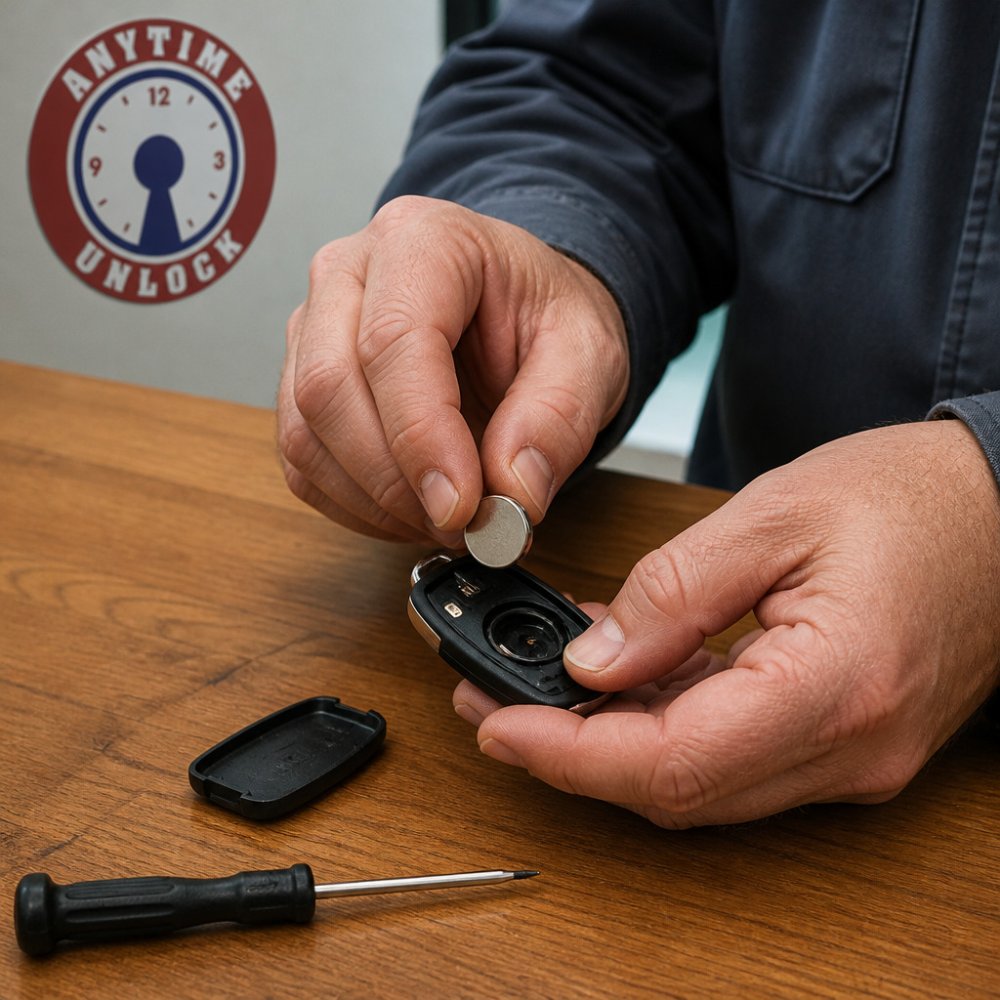
Step 1: Stand close to the car. Start within about three feet of the driver's door. Press lock and then unlock. Note which buttons respond.
Step 3: Test at different distances. Walk away slowly and press the lock button every few steps.
Step 4: Check the dash indicator. Start the car or turn the ignition on.
Step 5: Use the physical key. Unlock the door with the metal key.
Step 6: Write down your results. Note which buttons work, the approximate range, and any dash messages.
Diagnostic Decision Tree: Battery, Fob, Vehicle or Programming Fault
Most guides list possible causes. This tree tells you what each result means and what to do next, including checks that point to the vehicle rather than the fob. Work through it in order and write down each answer.
Question 1: Does the fob do anything at all when you press a button?
- No light, no click, no response at any distance: Go to the battery and contact checks in the battery-replacement section. If a fresh, correctly oriented battery still produces nothing, the fob itself is likely faulty or damaged.
- Yes, something happens: Go to Question 2.
Question 2: Does the fob work reliably within about three feet of the driver's door?
- No: Test a spare fob on the same vehicle. If the spare works, the original fob is the problem (battery, button, or internal damage). If both fail at close range, go to Question 5 for vehicle-side checks.
- Yes: Go to Question 3.
Question 3: Do all buttons work, or only some?
- Only some buttons: This points to a fob problem such as a worn button pad, a cracked circuit board, or liquid damage. A single dead button rarely indicates a programming fault.
- All buttons work at close range but range is short: This often points to a weak battery or a failing fob antenna. Replace the battery first, then retest range.
- All buttons work at normal range: Go to Question 4.
Question 4: Does the engine start, or does the dash show "key not detected" or a flashing security light?
- Remote buttons work but the engine will not start, or the dash reports no key: This is the classic split between remote-button function and immobilizer function. The fob's remote transmitter is working, but the transponder chip inside the key is not being recognized. That is a programming or immobilizer issue, not a battery issue.
- Remote buttons work and the engine starts normally: The fob is functioning. If you came here because of intermittent problems, go to Question 6.
Question 5: Does a known-good spare fob also fail on this vehicle?
- Yes, both fobs fail: The fault is probably on the vehicle side. Check these in order:
- Vehicle battery voltage. A weak car battery can cause receivers and immobilizers to behave erratically. Many auto parts stores will test a battery at no charge.
- Receiver and antenna location. Keyless receivers and antennas are often mounted near the rearview mirror, in the center console, or behind interior panels. A disconnected or damaged antenna can block fob signals even when the fob is fine.
- Recent repairs or bodywork. Collision repair, windshield replacement, or dashboard work can disturb antenna wiring or receiver connectors.
- Interference. Aftermarket phone chargers, dash cams, and certain LED bulbs can produce radio-frequency interference. Move those devices away and retest.
- No, the spare works: The original fob is the problem. Replace the battery, inspect for damage, and if it still fails, the fob likely needs replacement or reprogramming.
Question 6: Is the problem intermittent, and does it follow a pattern?
- Fails only in certain locations: Suspect interference from nearby transmitters, large metal structures, or crowded parking areas. Retest in a different location.
- Fails only in cold or hot weather: Suspect a marginal battery or a failing solder joint inside the fob.
- Fails randomly with no pattern: Suspect a failing fob or a vehicle-side connection issue. A spare-fob comparison is the fastest way to narrow it.
This tree gives a strong first diagnosis, but it cannot confirm the exact fault. Some problems overlap, and a vehicle's make and model can change which checks apply. If the tree points to the vehicle side, a professional with diagnostic equipment can confirm the receiver, antenna, or immobilizer fault faster than trial and error.
The decision tree leads to a different fix depending on what each test shows, so this table summarises the main outcomes and the next step for each.
| Result | Likely cause | Next step |
|---|---|---|
| No response at any distance | Battery or fob fault | Check battery and contacts, then replace fob if needed |
| Only some buttons work | Fob problem | Inspect buttons and circuit board |
| Remote works, engine won't start | Immobilizer or programming issue | Check transponder pairing |
| Spare fob also fails | Vehicle-side fault | Check vehicle battery, antenna and interference |
| Fails only in certain locations | Interference | Retest in a different location |
Can I Program a Key Fob Myself, and When to Call a Professional
Some vehicles allow owners to program a fob with a sequence of ignition turns, door presses, and button presses.
Check compatibility before you start. Self-programming availability varies by make, model, year, and fob type. A procedure that works on one model year may fail on the next.
What DIY programming typically requires:
- The vehicle owner's manual or a manufacturer-published procedure for your exact model year.
- All fobs you want paired, because many sequences require pairing every fob in one session.
- A working vehicle battery. A weak battery can interrupt the programming sequence.
What a professional may need:
- Proof of ownership, such as the vehicle title or registration, and a photo ID.
- Vehicle details: year, make, model, and VIN.
- Diagnostic equipment capable of communicating with the vehicle's immobilizer or body control module.
Call a professional when:
- Your manual has no DIY programming steps for your vehicle.
- The spare fob and the main fob both fail.
- You have lost all your keys.
A professional locksmith can bring the right equipment to your location. Anytime Unlock and George's Key Shop offers 24/7 mobile service, so help can arrive where your car is parked.
Car Key Fob Programming Cost and What Affects the Price
Costs vary widely, and Anytime Unlock and George's Key Shop has not published set prices for this service. You can compare transponder key programming costs against dealership pricing to see how the options differ.
Several factors usually shape the final price:
- Vehicle make and model. Some cars need extra diagnostic time.
- Fob type. Basic remotes cost less to program than transponder or smart keys.
- Whether a new fob is needed. A replacement adds parts cost to the labor.
Ask for an itemized quote before work begins. A clear quote lets you compare options and avoid surprises at the end of the job.
Dealer programming is one option. Locksmiths and mobile service providers are another. Compare the total cost of each, including any towing or travel fees, before you decide.
Booking Your Key Fob Check With Anytime Unlock and George's Key Shop
If your tests point toward programming, or the decision tree leaves you unsure, a professional check can settle it quickly. If you are locked out right now, you can find an emergency automotive lockout service for urgent help.
Have these details ready when you call:
- The year, make, and model of your vehicle.
- The number of working fobs you have.
- The results of your step-by-step tests.
Our advice is simple: test first, write down what you find, and then call. That approach saves time and helps the technician reach a fix faster.
Frequently Asked Questions
How can I tell if my key fob needs to be reprogrammed?
Common signs include the fob working only at close range, buttons that respond inconsistently, the doors unlocking but the engine not starting, or the security light flashing after a battery change. If the fob still fails after you replace the battery and test it near the vehicle, programming is a likely cause. Check the owner's manual for the vehicle's programming procedure, and if the fob was recently replaced or the vehicle lost power, a reprogramming step is often required.
Why does my key fob unlock the doors but not start the car?
Remote lock and unlock functions use a radio signal, while starting the engine depends on the immobilizer reading a transponder chip inside the fob. If the doors respond but the car will not start, the transponder may not be recognized by the vehicle. This points to a programming or transponder issue rather than a dead battery, since the remote buttons still function. A locksmith or dealer can check whether the transponder is paired with the vehicle.
Can a dead key fob battery make the fob seem unprogrammed?
Yes. A weak or dead coin-cell battery can cause intermittent button response, short range, or no response at all, which can look like the fob has lost its programming. Replace the battery with the correct type listed in the owner's manual, then test the fob again. If it works after the swap, the battery was the cause. If it still fails, move on to programming and vehicle-side checks.
Can I program a car key fob myself?
Some vehicles allow owners to pair a replacement fob using a documented sequence of ignition turns, door cycles, and button presses, as described in the owner's manual. Many newer vehicles require professional tools to program transponder keys or fobs. Attempting a reset incorrectly can lock out the fob or change settings, so confirm the procedure for your make, model, and model year before starting. When in doubt, a qualified locksmith is the safer option.