 how-to
How to Rekey House Locks: A Step-by-Step Guide
Table of Contents
- Why Rekeying Your House Locks Beats Replacing Them
- Tools and Supplies You Need to Rekey House Locks
- Step-by-Step: How to Rekey House Locks Yourself
- How Long Does It Take to Rekey a Lock?
- Hiring a Professional Locksmith for Rekeying
- Smart Lock Compatibility and Keyed Alike Systems
- Troubleshooting Common Rekeying Problems
- Frequently Asked Questions
Last Updated: September 11, 2026
Why Rekeying Your House Locks Beats Replacing Them
Rekeying house locks is the practice of changing the internal pin configuration of an existing lock cylinder so old keys stop working and new ones take their place. It costs less than replacing the hardware and takes less time than most homeowners expect. When you move into a new property, you have no idea how many copies of the old key are floating around. Rekeying solves that problem without touching the door itself.
At Anytime Unlock and George's Key Shop, we've handled residential lock work since 1971. Replacement makes sense when the hardware is worn, damaged, or you want a different finish or function. Otherwise, rekeying gives you the same security outcome for a fraction of the effort. The lock body, deadbolt, and strike plate all stay exactly where they are.
The ANSI/BHMA grading standards for residential locks are worth understanding here: a quality cylinder is worth keeping, and rekeying preserves it.
Tools and Supplies You Need to Rekey House Locks
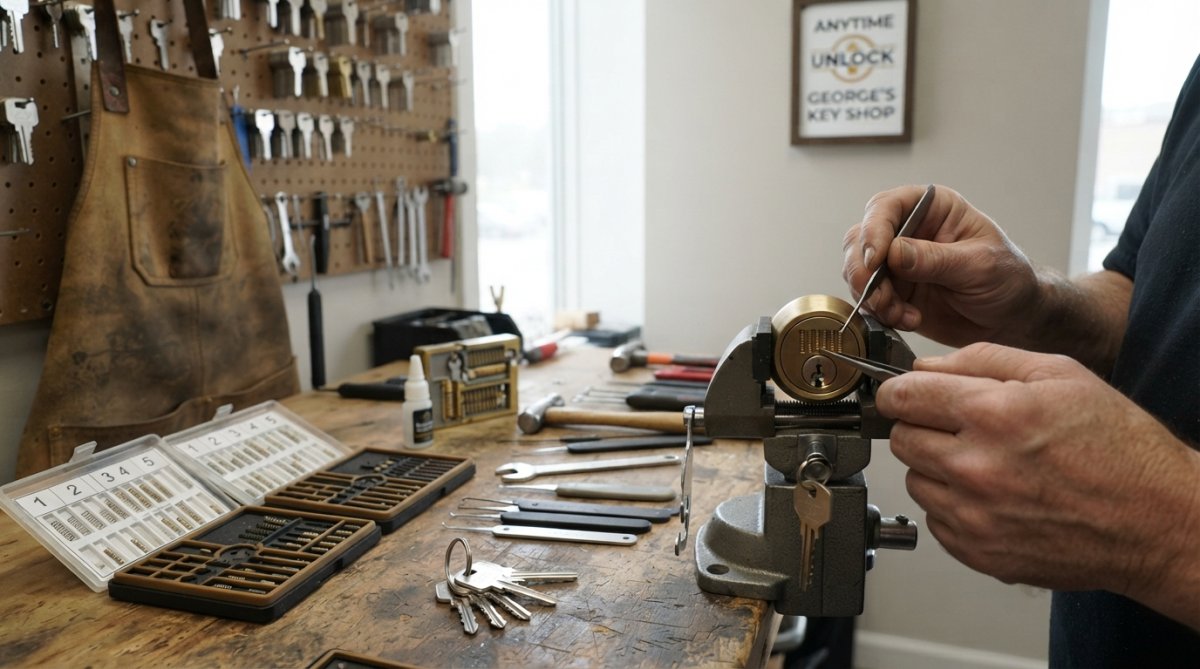
A basic rekeying kit contains everything required for most residential cylinders: a plug follower, a set of key pins in multiple lengths, springs, a pinning tool, and a cylinder removal tool. You'll also need a screwdriver that matches your lock's mounting screws and a clean tray to keep pins from rolling away.
The plug follower is the piece most beginners underestimate. It's a cylindrical rod sized to the lock core, and its job is to push the plug out while keeping the springs and pins from launching across the room. Without it, you'll spend twenty minutes on your hands and knees.
- Plug follower, keeps springs and pins captured during cylinder removal. Follower diameter must match the plug diameter; a loose follower lets pins slip past the gap.
- Pin kit or rekeying kit, color-coded key pins in graduated lengths. Universal kits cover the common .003-inch increment pin sizes used across most residential cylinders (builderonline.com).
- Pinning tool, sets pins into the plug without dropping them. A tweezers-style pinning tool is easier for beginners than a straight pick.
- Snap ring pliers, for removing the retaining clip on many deadbolt designs.
- Key bitting chart, maps your new key's cuts to the correct pin stack. Each brand publishes its own depth-and-space chart.
- Cylinder removal tool, a spanner or specialty wrench for locks where the cylinder is retained by a threaded collar rather than screws.
Brand-Specific Tool Notes
The two dominant residential brands in the U.S. market diverge in ways that change your tool list:
- Kwikset cylinders use a retaining clip on the rear of the plug that pops off with a small flathead or snap ring pliers. Kwikset's SmartKey system uses a completely different rekeying mechanism, a dedicated SmartKey rekey tool and the existing working key, and cannot be rekeyed with a standard pin kit.
- Schlage cylinders typically use a C-clip or a threaded cap depending on the model line. Schlage's pin chambers accept standard .003-inch increment pins, so a universal kit works.
- Defiant, Gate House, and other big-box store brands are frequently Kwikset-compatible in pin geometry, but the follower diameter and clip style can vary. Measure the plug before assuming a universal follower fits.
ANSI/BHMA grading standards for residential locks
Step-by-Step: How to Rekey House Locks Yourself
The process follows a fixed sequence: remove the cylinder, disassemble the plug, swap the pins, and reassemble. Work on a table with a raised edge, and keep every small part in one place. Most homeowners finish a single lock in under an hour once they've done it once.
Step 1: Remove the Lock Cylinder
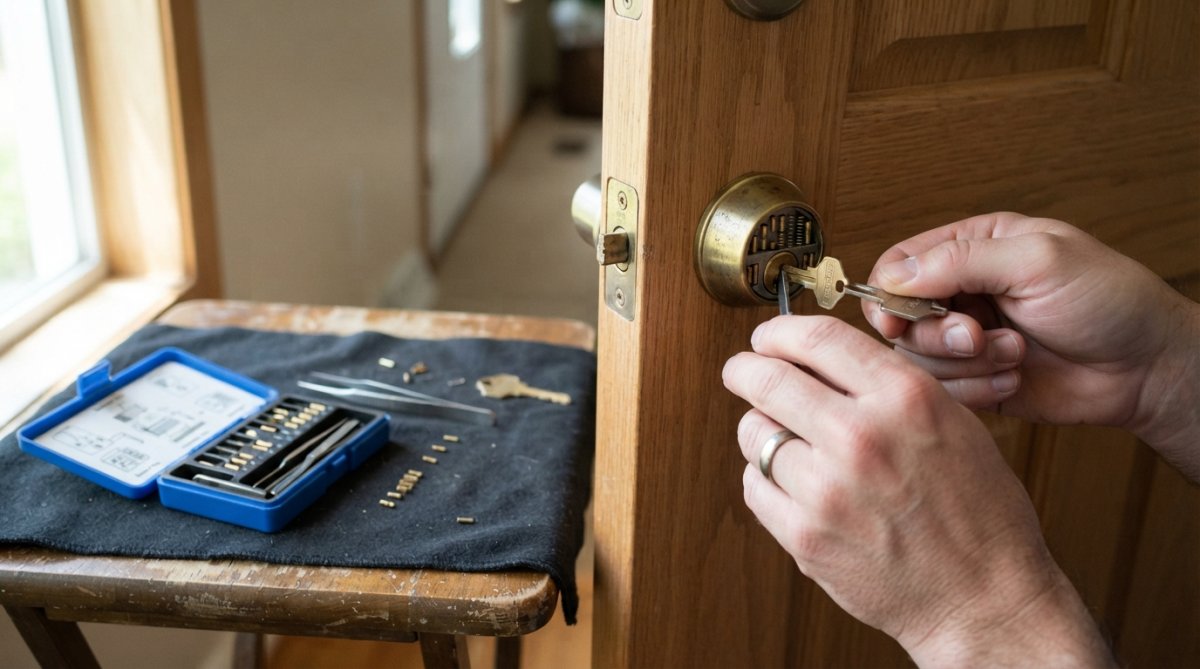
Start on the interior side of the door. Remove the mounting screws holding the interior trim plate, then slide the interior assembly off the door. The cylinder typically sits in a housing that either unscrews or slides free once the trim is removed. On a deadbolt, you'll usually find two screws running through the door that hold both halves together.
Keep the screws in a cup. Losing one means a trip to the hardware store mid-job. Once the cylinder is free, set it on your work surface with the keyway facing up.
Step 2: Disassemble the Plug and Remove Pins
Insert the current key and turn it slightly, about 15 degrees, to align the pin stacks with the top of the cylinder housing. This is the step that trips up first-timers. If you skip the turn, the pins bind and the plug won't slide out.
Push the plug follower in behind the plug as you withdraw it. The follower holds the springs and key pins in the housing so nothing scatters. With the plug out, tip the old pins onto your tray. Note the order: bottom pins sit closest to the keyway, and master pins, if present, sit above them.
Step 3: Insert New Pins and Reassemble
Match each chamber to the new key's bitting. A key bitting chart tells you which pin length corresponds to each cut depth on the key. Drop the correct key pin into each chamber of the plug, then slide the plug back into the housing while pushing the follower out from behind.
Seat the plug fully, reinstall the retaining clip or snap ring, and test the new key before you remount anything. It should turn smoothly with light pressure. If it binds, stop and check the pin order rather than forcing it.
How Long Does It Take to Rekey a Lock?
Rekeying a single lock takes a homeowner roughly 30 to 60 minutes on a first attempt and closer to 15 to 20 minutes per lock once the process is familiar. A professional typically rekeys several locks in the time a beginner spends on one.
The variables that stretch the timeline are lock design and door count. A standard exterior knob is quick. A deadbolt with a snap ring adds a few minutes. Older locksets with worn springs take longer because you'll want to replace the springs while you're in there.
If you're rekeying every exterior door in a house, plan for an afternoon rather than an hour. Doing them all at once is worth it, since you'll key them alike and carry a single key.
Hiring a Professional Locksmith for Rekeying
Calling a professional makes sense when you have several locks, an unfamiliar brand, or a lock that's already misbehaving. A locksmith arrives with a full pin kit, handles the cylinder removal and pin matching in one visit, and can key every exterior door alike on the spot. For anyone who has never opened a lock cylinder, the risk of a bent spring or a lost snap ring usually outweighs the savings.
Anytime Unlock and George's Key Shop provides mobile residential locksmith service, so the work happens at your door rather than in a shop. That matters for a simple reason: a cylinder that's removed and carried away leaves your home unsecured in the meantime.
Pricing varies with the number of locks, the hardware brand, and whether any cylinders need replacement. Get a written quote before work begins, and confirm whether the quote covers every lock or just the first one.
Smart Lock Compatibility and Keyed Alike Systems
Most guides treat smart locks as an afterthought. This section covers the compatibility question directly, because it changes whether rekeying is even the right move.
Smart Locks and Electronic Deadbolts
Smart locks fall into three categories, and only one of them is rekeyable in the traditional sense:
- Fully electronic locks with no keyway (keypad-only or app-only models). There is no pin tumbler cylinder to rekey. Access is managed by changing user codes in the app, not by swapping pins. If you lose a code or a phone, you revoke access digitally.
- Hybrid smart locks with a traditional keyway (many models from Schlage, Yale, and Kwikset). These have a standard pin tumbler cylinder that can be rekeyed with a normal pin kit, but the cylinder is often a proprietary shape or uses a different follower diameter. Check the model's documentation before buying a kit.
- Smart locks with user-rekeyable cylinders (Kwikset SmartKey-equipped models). These rekey with the manufacturer's tool and a working key, not a pin kit.
A common pattern is that a homeowner buys a smart lock for the front door and wants the back and garage doors keyed to match. That usually isn't possible across brands, because each manufacturer's keyway is proprietary. The practical workaround is to keep the smart lock on its own credential and rekey the remaining mechanical locks alike among themselves.
Keyed Alike Systems
Keyed alike is the more practical upgrade for a house full of standard locks. Keyed alike means every exterior lock uses the same key, so one key opens the front door, the back door, and the garage entry. Master keying goes a step further: a master key opens everything, while individual keys open only specific doors, which suits a home with a rental unit or a home office.
| Setup | Keys You Carry | Best For | Rekey Complexity |
|---|---|---|---|
| Keyed different | One per door | Rentals with separate tenants | Low |
| Keyed alike | One for all doors | Most single-family homes | Low |
| Master keyed | Master plus individual keys | Homes with staff or tenants | High |
| Smart lock | None, or an app | Frequent guests, remote access | Not applicable |
The tradeoff with keyed alike is real: lose that one key and every door is exposed. That's why rekeying after a lost key matters more in a keyed-alike setup than in any other configuration.
Keyed alike also has a mechanical limit. Cylinders from different manufacturers use different keyways, so a Schlage cylinder and a Kwikset cylinder cannot be keyed to the same key without replacing one of them. To key a mixed-brand house alike, you either standardize on one brand or accept two keys.
Troubleshooting Common Rekeying Problems
The key turns but the lock feels gritty, which almost always means a pin is sitting in the wrong chamber or a spring is compressed. Reopen the cylinder and recheck the pin stack against the bitting chart before you assume the lock is bad.
A key that won't insert fully points to a pin that's too long for that chamber. A key that inserts but won't turn usually means the plug isn't seated all the way, or the retaining clip isn't fully in its groove. Both are assembly errors, not hardware failures.
If a lock worked before you started and doesn't work after, the problem is in your work, not the lock. That's the single most useful troubleshooting rule in locksmithing.
Rekeying your own locks is a satisfying afternoon project, but it isn't the right call for every home. If you have multiple doors, an unfamiliar brand, or a lock that's already giving you trouble, the risk of a half-finished job leaves your house less secure than when you started. Anytime Unlock and George's Key Shop handles residential rekeys with mobile service and the same team that's been working on locks since 1971. Get a free quote.
Frequently Asked Questions
Can I rekey my locks myself?
Yes, you can rekey your own locks if you have the right tools and some patience. A lock rekeying kit with a plug follower, pin tweezers, and new pins costs less than hiring a pro for multiple locks. However, older or high-security locks may need special pins or tools. If your lock has security pins or you are unsure, hiring a professional locksmith for rekeying is safer.
Is it cheaper to rekey or change locks?
Rekeying is almost always cheaper than replacing locks because you keep your existing hardware and only change the internal pins. Rekeying also takes less time and avoids the cost of new deadbolts or knobs. The exact difference depends on the number of locks and whether you do it yourself or hire a pro. For a free quote on your specific situation, contact a local locksmith.
How do I get all my house locks keyed the same?
To get all your house locks keyed the same, you need to rekey each lock to match a single key. This is called keyed alike. You can do this yourself by purchasing a rekeying kit with pins that match your chosen key, or hire a locksmith who can pin all cylinders to one key. Keyed alike systems make daily life easier and eliminate the need for multiple keys.
What tools do I need to rekey a door lock?
You need a lock rekeying kit, which typically includes a plug follower, pin tweezers, a cylinder removal tool, and a set of new pins and springs. You will also need a screwdriver to remove the lock from the door. Some kits come with a key gauge and a pinning chart. If you have a smart lock, check compatibility before starting.