 how-to
How to Replace Lost Car Keys: 2026 Step-by-Step Guide
Table of Contents
- Step 1: Secure Your Vehicle and Confirm the Loss
- Step 2: Identify Your Key Type Before You Call Anyone
- Step 3: Locate a Spare Key or Your Key Code
- Step 4: What Is a VIN Number Used For in Key Replacement?
- Step 5: Automotive Locksmith vs. Dealership: Which Is Right for You?
- Step 6: Understanding the Cost of Replacing a Car Key Fob
- Step 7: Emergency Lockout Safety and Roadside Assistance
- Frequently Asked Questions
Last Updated: September 17, 2026
Step 1: Secure Your Vehicle and Confirm the Loss
Having lost car keys triggers panic, but the first hour determines whether this stays a minor inconvenience or becomes a security problem. This guide from Anytime Unlock and George's Key Shop walks through how to replace lost car keys, from realizing they're gone to driving again.
Secure the vehicle immediately:
- Park in a locked garage or well-lit, high-traffic area if possible
- Remove valuables from the cabin
- Do not leave the vehicle unattended in an isolated location
- Note your license plate, VIN, and insurance details before you call anyone
Step 2: Identify Your Key Type Before You Call Anyone
Knowing your key type before you call a locksmith or dealership prevents overpaying. There are three broad categories.
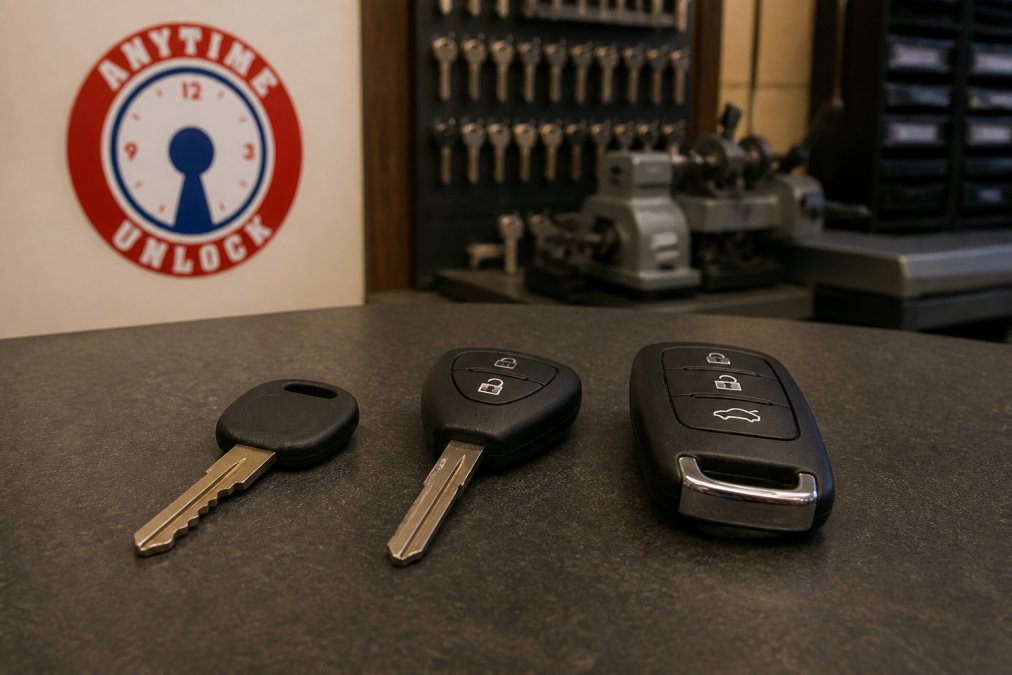
Traditional vs. Transponder vs. Smart Keys
A traditional key is a simple cut metal blade with no electronics, cheapest and easiest to replace, though rare on vehicles built after the mid-2000s.
Step 3: Locate a Spare Key or Your Key Code
The fastest replacement is often the spare key you forgot you had. Check with family members, your glovebox, a desk drawer at work, or wherever you keep documents.
Step 4: What Is a VIN Number Used For in Key Replacement?
The VIN (Vehicle Identification Number) is a 17-character code identifying your specific vehicle, and it's central to key replacement. A VIN number is used in key replacement to verify your vehicle's exact make, model, year, and factory key specifications, letting a locksmith or dealer cut and program a key matching your car's original configuration.
You'll find the VIN in several places:
- On the driver's side dashboard, visible through the windshield
- On the driver's side door jamb sticker
- On your vehicle registration and insurance documents
- On the engine block or firewall
Step 5: Automotive Locksmith vs. Dealership: Which Is Right for You?
The right choice depends on your key type, your vehicle's model year, and whether the car will start. Use the decision matrix below before calling anyone.
The VIN-Based Key Cutting Process (Why It Matters Here)
Both locksmiths and dealers start from your VIN, which tells the key machine your key blank profile and transponder or smart key frequency. Then the paths diverge.
- Locksmiths typically decode the existing lock cylinder on-site using a key origination tool or impressioning, then cut the blade on a mobile key machine. For transponder and smart keys, they program the chip through the OBD-II port using aftermarket diagnostic tools.
- Dealerships pull the factory key code from the manufacturer's database using your VIN plus proof of ownership, then cut the key on an OEM machine and program it with proprietary software tied to that brand.
Decision Matrix
| Your Situation | Best First Call | Why |
|---|---|---|
| Traditional metal key, car starts | Locksmith | Cheapest, fastest, no programming needed |
| Transponder key, car starts | Locksmith | Can cut and program on-site for most models |
| Smart key / push-to-start, car starts | Locksmith first, dealer as backup | Aftermarket tools cover most 2010+ vehicles; brand-new models may need dealer |
| Any key type, car will not start | Locksmith with mobile programming | Avoids towing; dealer often requires the vehicle on-site |
| Lock cylinder damaged or missing | Dealership | They can cut from VIN without touching the lock |
| Vehicle under 2 years old, proprietary system | Dealership | Aftermarket tools lag new releases by months |
| You need two or more keys | Locksmith | Per-key cost drops sharply when programmed in one visit |
What Each Option Actually Costs You
Dealership pricing follows the manufacturer's parts and labor schedule and is rarely negotiable: the key blank is modest, programming labor is the larger charge, and some dealers add a diagnostic fee. Locksmith pricing varies with travel distance, time of day, and your immobilizer's equipment.
DIY vs. Professional Programming
DIY key programming is possible on a narrow slice of vehicles, know which slice you're in before buying anything.
- Traditional keys: No programming exists, but cutting the blade needs a key machine, so DIY is impractical.
- Some transponder keys (mostly older models): A few vehicles allow on-board programming via ignition cycles, door locks, and button presses; your owner's manual describes the procedure.
- Most transponder and nearly all smart keys: Programming needs a diagnostic tool through the OBD-II port, often plus a security code or PIN only a dealer or registered locksmith can retrieve. Consumer-grade scanners can't do immobilizer pairing.
Step 6: Understanding the Cost of Replacing a Car Key Fob
The cost of replacing a car key fob varies by key type, vehicle make, and whether you use a locksmith or dealership. Traditional keys are cheapest, transponder keys cost more due to the chip and programming, and smart key fobs sit at the top.
Typical Price Ranges by Key Type
These ranges reflect common market patterns; your quote depends on your vehicle, location, and time of day. Contact Anytime Unlock and George's Key Shop for a quote based on your specific vehicle.
| Key Type | Locksmith Range | Dealership Range |
|---|---|---|
| Traditional metal key | Lowest tier | Slightly higher, plus appointment |
| Transponder (chip) key | Mid tier, includes programming | Higher, often includes diagnostic fee |
| Smart key / key fob | Highest tier, includes cutting and pairing | Highest, sometimes requires towing |
| Emergency / after-hours | Adds a premium | Usually unavailable outside business hours |
What Drives the Final Price
- Key type: Traditional, transponder, or smart key
- Programming complexity: Some vehicles require specialized software or a security code retrieval
- OEM vs. aftermarket: Dealer parts typically cost more; OEM-equivalent aftermarket parts close most of the gap
- Emergency vs. scheduled service: After-hours calls carry a premium
- Additional keys: Ordering two at once often costs less per key because the programming labor is shared
- Towing: If the vehicle must go to a dealer, add the tow to the total
Because pricing depends on your vehicle and key type, request a quote before committing. Anytime Unlock and George's Key Shop provides transparent quotes up front, so you know the price before a technician arrives.
Is Key Replacement Coverage Worth Adding to Your Auto Policy?
Key replacement coverage is usually an add-on to your auto policy or bundled into a mechanical breakdown or roadside assistance endorsement, not part of standard comprehensive coverage, which is why claims often get denied.
How the math usually works:
- The add-on premium is a small annual charge, often in the low double digits per year.
- The coverage typically reimburses a set amount per key, with a cap per policy period.
- Most policies require a police report or a notarized statement for lost keys, and some require proof that the loss was not due to negligence.
- Reimbursement is usually after the fact, meaning you pay the locksmith or dealer first and file for reimbursement.
When it makes sense to add:
- You drive a vehicle with a smart key system, where a single replacement can exceed the annual premium by a wide margin.
- You have a history of losing keys, or you share the vehicle with a teenager.
- Your policy already bundles roadside assistance and the add-on is inexpensive to attach.
When it does not:
- You drive an older vehicle with a traditional or simple transponder key, where the replacement cost is low enough that the premium rarely pays back.
- Your policy caps reimbursement at an amount below your likely replacement cost.
- You already carry a credit card or auto club benefit that covers lost keys.
Step 7: Emergency Lockout Safety and Roadside Assistance
If you're locked out right now, safety comes first. Standing on a highway shoulder or in an unfamiliar lot at night is risky, move to a safe, visible location and call for help rather than forcing the door.
When you call, have this ready:
- Your location and a nearby landmark
- Vehicle make, model, and year
- Your VIN
- Proof of ownership and photo ID
Frequently Asked Questions
Can I replace a lost car key myself?
You can replace a traditional metal key yourself if you have a spare to copy, but transponder and smart keys require programming to match your vehicle's immobilizer system. DIY programming tools exist, but they often fail on newer models and can lock out your system. For most drivers, a professional automotive locksmith is faster and safer than attempting a DIY fix.
How much does it cost to replace a car key if lost?
The cost of replacing a car key fob depends on the key type and vehicle make. Traditional keys cost the least, while smart keys with remote start cost the most. Contact Anytime Unlock and George's Key Shop for a quote based on your specific vehicle.
What information do I need to provide a locksmith to get a new key?
You will need proof of ownership, such as your vehicle title or registration, and a valid driver's license. The locksmith will also need your VIN to cut and program the key correctly. Having these documents ready speeds up the process and helps verify you are the rightful owner before any work begins.
Does insurance cover the cost of lost car keys?
Some auto insurance policies cover key replacement through roadside assistance or comprehensive coverage, but many do not. Check your policy details or call your provider to confirm. If you have a key insurance add-on, it may reimburse the cost of replacing car keys. Otherwise, you will pay out of pocket, so ask for a quote upfront.
Losing your car keys is stressful, but it's a solvable problem when you know the steps. The challenge is that most drivers wait until an emergency to learn their key type, their VIN location, and their coverage options. Anytime Unlock and George's Key Shop handles automotive lockouts and key programming with 24/7 mobile service, transparent quotes, and a track record dating back to 1971. Get a free quote today and get back on the road without the dealership markup.