 comparison
Affordable Alternatives to Dealer Key Programming
Table of Contents
- Why Dealership Key Programming Costs More
- Automotive Locksmith Car Key Programming as a Cost-Effective Option
- DIY Car Key Programming: What You Need to Know
- Car Key Fob Programming Cost Comparison: Locksmiths vs. Dealerships
- Key Fob Compatibility by Vehicle Make and Model
- Replacement Key Fobs and Transponder Keys: Quality and Reliability
- How to Choose the Right Alternative for Your Situation
- Frequently Asked Questions
Last Updated: October 18, 2026
Why Dealership Key Programming Costs More
Dealership key programming carries a premium: dealers program through manufacturer systems requiring specialized access and licensing, maintain certified technicians, and invest in proprietary equipment. Their overhead, rent, staffing, manufacturer compliance, is baked into every job.
The dealership model also assumes lower volume per location, spreading fixed costs across fewer transactions than a mobile locksmith, and technician hourly rates include training, equipment maintenance, and facility expenses a mobile locksmith doesn't carry the same way.
Dealerships also bundle programming with other services or mark it up within a larger repair, with little incentive to compete on key programming alone.
Automotive Locksmith Car Key Programming as a Cost-Effective Option
An automotive locksmith can program most car keys and key fobs at a fraction of dealership rates.
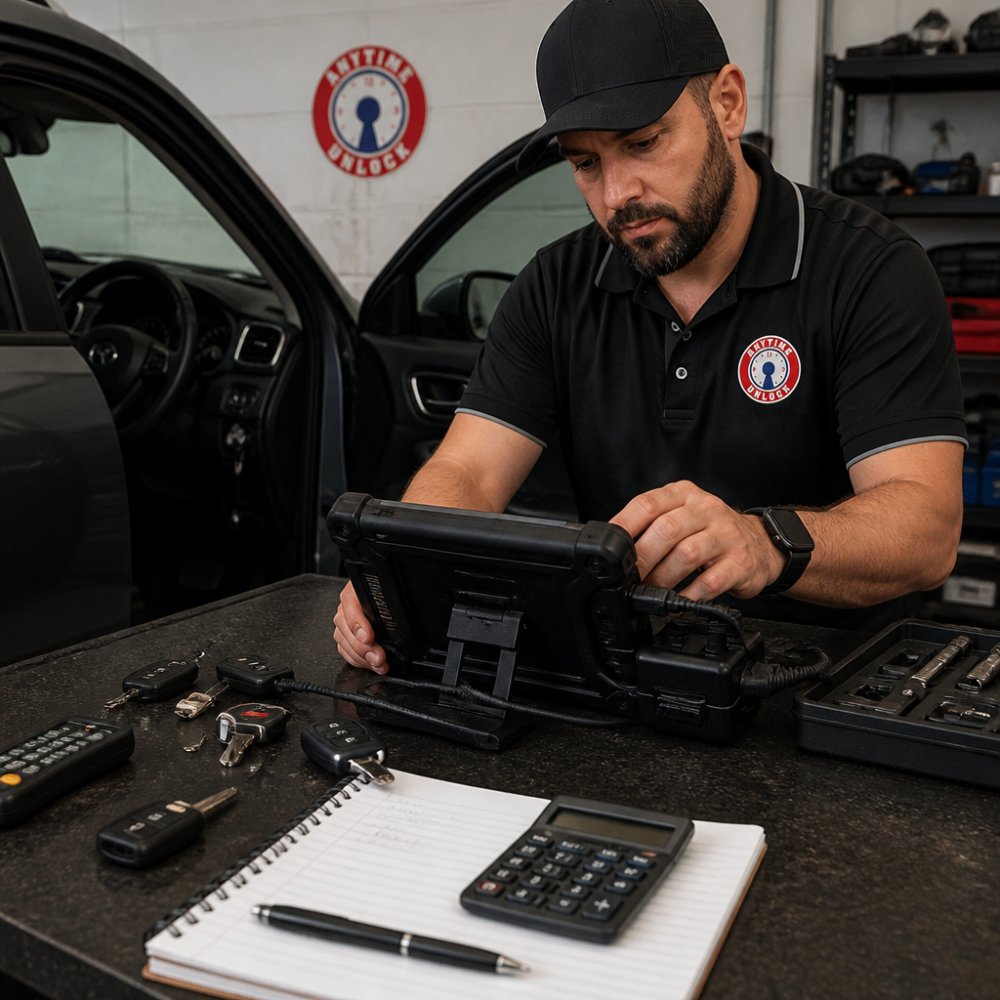
Locksmiths typically charge for service calls, travel time, and programming, and many offer 24/7 availability dealerships don't.
The key distinction is expertise.
When comparing car key fob programming cost, locksmiths typically charge based on the specific vehicle, the type of key, and whether additional services are needed.
DIY Car Key Programming: What You Need to Know
DIY key programming sits on a spectrum: on-board programming using the vehicle's own computer costs nothing but time; buying a professional programmer and learning an immobilizer system well enough not to brick a key sits at the other end. Know where the line is before starting.
Vehicles that support on-board programming
On-board programming means adding a key through a sequence the vehicle performs itself, typically inserting a working key, cycling the ignition in a set pattern, then inserting the new key so the immobilizer learns it. It works only on vehicles designed to allow it, most commonly certain older and mid-generation domestic models; many Asian and European vehicles, and nearly all recent models with encrypted immobilizers, expose no on-board add-key sequence.
The tool tier, and what it really costs to own
Professional programmers such as the Lonsdor K518 PRO, OBDSTAR X300 Classic G3, and Autel MaxiIM IM508S are built for technicians, not one-time users. The sticker price is only the entry fee. Real ownership cost includes:
- Software and firmware updates, which are periodic and often required to keep newer vehicles supported.
- Brand or vehicle subscriptions, which some tools charge per manufacturer or per vehicle to unlock programming functions.
- Adapters and cables for different immobilizer and key types, sold separately.
- The keys and fobs themselves, which you still have to buy and which must match your vehicle's chip and frequency.
Run the break-even before buying: total tool cost divided by a locksmith's per-key charge equals the jobs needed to justify the purchase. For a single spare key, that number is almost always higher than paying a professional once.
Compatibility and security limits by vehicle generation
Compatibility is not just make and model, it is immobilizer generation. Older rolling-code systems are forgiving and most likely to accept on-board or entry-level tool programming. Mid-generation transponder systems often need a capable programmer plus a compatible blank key. Recent encrypted immobilizers frequently require security access only manufacturer-level or licensed aftermarket systems can obtain, which is when DIY stops being an option.
Common DIY failures and how to recover
- Security lockout. Repeated failed attempts can put the immobilizer into a timeout that disables starting. On some vehicles this clears after a wait; on others it requires a capable scan tool or dealer access to reset.
- Erased working keys. Some procedures, done out of order, can drop existing keys from the vehicle's memory, turning a spare-key job into an all-keys-lost job.
- Bad blanks. A fob with the wrong chip, frequency, or cut may program partially and then fail intermittently, which is harder to diagnose than a clean failure.
- Partial programming. A key that starts the car but will not lock or unlock remotely usually means the remote function was never paired, a separate step from immobilizer learning.
When to stop and call a professional
Call a professional if your vehicle is a recent model with an encrypted immobilizer, if you've lost all keys rather than adding a spare, if a failed attempt has left the car unable to start, or if you can't confirm your exact model year and trim against a known working procedure. A locksmith verifies key quality before programming and can recover from a lockout, the part DIY guides leave out.
Car Key Fob Programming Cost Comparison: Locksmiths vs. Dealerships
Your out-the-door price is the sum of five line items: the key or fob itself, cutting (if there's a physical blade), programming labor, any mobile service call or travel fee, and any software or subscription charge passed through. Dealers and locksmiths bundle these differently, so similar-looking quotes can differ by hundreds of dollars.
The five cost components, itemized
- Key or fob hardware. An OEM fob from a dealer is typically the single largest line item. Aftermarket and refurbished fobs cost less but vary in chip and frequency quality (covered in the next section).
- Key cutting. Transponder keys with a physical blade must be cut to your lock. Smart keys and push-to-start fobs often have no blade and skip this step entirely.
- Programming labor. This is time-based at a dealer and often flat-rate at a locksmith. It is the line item most affected by how new and how encrypted your vehicle is.
- Mobile service call and travel. A dealer charges you to bring the vehicle to them (in time, if not in dollars). A mobile locksmith charges a call fee, sometimes distance-based.
- Software, subscription, and access fees. Dealers absorb manufacturer system access into labor. Independent shops and DIY tool owners may pay per-vehicle or per-brand subscription fees that are easy to overlook.
How the two models bundle those components
| Cost component | Dealership | Automotive locksmith |
|---|---|---|
| Key/fob hardware | OEM pricing, usually highest | OEM, aftermarket, or refurbished options |
| Key cutting | Included in service | Included or small add-on |
| Programming labor | Higher hourly or flat rate | Lower flat rate, varies by vehicle |
| Mobile service call | Not offered, you drive in | Call fee, sometimes distance-based |
| Software/access fees | Absorbed into labor | Usually absorbed; confirm upfront |
| Availability | Business hours, appointment often days out | Often same-day, 24/7 in many markets |
| All-keys-lost recovery | Supported | Supported by most full-service locksmiths |
The pattern most practitioners report: for a routine spare key on a common vehicle, the locksmith total lands meaningfully below the dealer total because hardware and labor are both lower. For an all-keys-lost situation on a newer encrypted vehicle, the gap narrows, both providers need comparable equipment and access, so availability decides rather than price.
The break-even question for tool buyers
If you're tempted to buy a programmer instead of paying a provider, run the break-even math first. A professional-grade programmer is a capital purchase: add software updates, brand or vehicle subscriptions, adapters and cables, and the keys themselves, then divide total tool cost by what a locksmith charges per key. For a one-time spare key, that number is almost always higher than hiring the job out; the tool math only works for people who program repeatedly, such as a small shop or a serious hobbyist working on a fleet.
When the dealer is the rational choice
Price is not the only variable. Choose the dealer when your vehicle is under a manufacturer warranty and you want the work documented in the service record, when it uses a proprietary system independent equipment cannot reach, or when a prior failed attempt triggered a security lockout needing manufacturer-level access to clear.
For everything else, a spare key, a replacement fob, a second remote, get a written quote from a mobile locksmith and compare it line by line against the dealer estimate. The provider that itemizes clearly is usually the one that will not surprise you at pickup.
Key Fob Compatibility by Vehicle Make and Model
Not all key fobs work with all vehicles.
Locksmiths maintain vehicle compatibility databases and verify a replacement fob before programming.
Immobilizer systems have grown more sophisticated: older vehicles use simpler rolling-code systems that are easier to program, while newer ones use encrypted systems requiring professional-grade diagnostic tools.
When shopping for a replacement key fob, confirm the exact vehicle year and model with the locksmith or online retailer.
Replacement Key Fobs and Transponder Keys: Quality and Reliability
Replacement key fob and transponder key quality directly affects reliability and longevity. Dealership keys come from the manufacturer and carry a warranty; aftermarket keys vary widely.
A transponder key contains a microchip that communicates with your immobilizer.
Dealership keys cost more but guarantee compatibility and quality; aftermarket keys cost less but require careful vetting.
When you need a replacement key, ask the locksmith about their sourcing and warranty.
How to Choose the Right Alternative for Your Situation
Your choice depends on urgency, vehicle compatibility, budget, and technical comfort level.
Choose a locksmith if you need service quickly, want transparent pricing, and prefer professional expertise.
Choose dealership service if your vehicle is under warranty and you want manufacturer-backed programming, or if it requires proprietary systems only dealerships can access.
For most situations, an affordable alternative to dealer key programming through a qualified locksmith offers the best balance of cost, speed, and reliability.
Frequently Asked Questions
Can a locksmith program a car key instead of going to a dealership?
Yes. An automotive locksmith can program most car keys and key fobs without visiting a dealership. Locksmiths use specialized programming equipment and diagnostic tools to handle transponder keys, remote keyless entry systems, and immobilizer programming for many vehicle makes and models. This option typically costs significantly less than dealer programming and often includes mobile service to your location.
What is the cheapest way to get a key fob programmed and cut?
The most affordable option depends on your vehicle and situation. For newer vehicles with on-board programming capability, DIY programming using your spare key may cost nothing beyond the key blank itself. If DIY is not possible, an automotive locksmith typically charges less than a dealership for both key cutting and programming. Locksmiths offer mobile service, which can reduce your total time and transportation costs compared to a dealership visit.
Can I program a car key myself, and is it safe?
Some vehicles support self-programming through on-board procedures that don't require special tools. However, success depends on your vehicle's year, make, and model. If your car doesn't support on-board programming, DIY attempts with aftermarket tools carry risks: failed programming, security system lockouts, or incompatibility issues that may require professional recovery. Many vehicle owners find professional automotive locksmith car key programming safer and more reliable than attempting DIY methods.
How do I know if a replacement key fob is compatible with my car?
Key fob compatibility depends on your vehicle's year, make, and model. Dealerships sell OEM fobs guaranteed to work, but aftermarket fobs can also be compatible if they match your vehicle's security system and frequency. Before purchasing, confirm your vehicle's exact year and model, and verify the fob supports your car's remote keyless entry system. A locksmith can verify compatibility and program the fob to your vehicle's immobilizer system, ensuring it works correctly.
How much does car key fob programming cost?
Programming costs vary based on your vehicle, the type of key or fob, and whether you visit a dealership or locksmith. Dealerships typically charge more due to overhead, while automotive locksmiths generally offer competitive pricing. Mobile locksmiths may charge a service call fee but eliminate dealership wait times. For accurate car key fob programming cost information specific to your vehicle and location, contact a local automotive locksmith or dealership directly for a quote.
When you need a key programmed or replaced, don't assume the dealership is your only option. A professional automotive locksmith delivers the same result at a lower cost with faster turnaround times. Anytime Unlock and George's Key Shop offers 24/7 mobile locksmith service, free quotes, and expert programming for virtually any vehicle make and model. Contact us for a free estimate and discover how much you can save compared to dealership pricing. Get a Free Quote today.