 blog
blog
Best Locksmith Services for Business: 2026 Guide
Table of Contents
- What Makes a Locksmith Service the Best for Your Business?
- Commercial Access Control Systems: Keyless Entry and Beyond
- How to Choose a Commercial Locksmith: 7 Questions to Ask
- Commercial Locksmith Service Costs: What Drives the Price
- Emergency Lockout Assistance and 24/7 Mobile Response
- Maintenance Schedules and Compliance: What Most Businesses Miss
- Frequently Asked Questions
Last Updated: September 12, 2026
What Makes a Locksmith Service the Best for Your Business?
Finding the best locksmith services for business starts with one question: can they respond when it matters and document what they did? A commercial locksmith is a security partner who installs, maintains, and repairs the locks and access hardware that protect your building, assets, and people. At Anytime Unlock and George's Key Shop, we've handled commercial lockouts, hardware failures, and security upgrades since 1971. The difference between a good provider and a costly one usually comes down to three things: response time, credentials, and whether they understand your compliance obligations.
The stakes are higher than most owners realize. A broken panic bar or a failed electronic strike isn't just an inconvenience; it can violate fire code, void an insurance claim, or leave a liability exposure you didn't know you had. Below, we'll walk through what separates a dependable commercial locksmith from a cheap one, how to evaluate access control options, and what actually drives the price.
Commercial Access Control Systems: Keyless Entry and Beyond
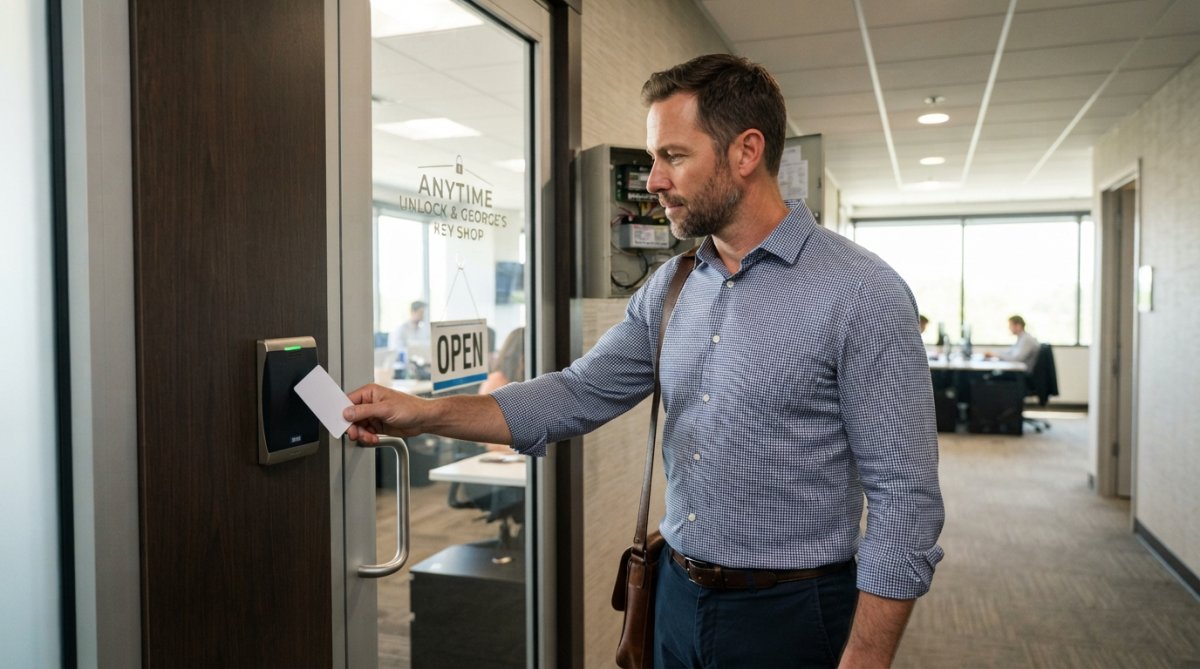
Commercial access control systems replace mechanical keys with credentials: cards, fobs, PIN codes, mobile Bluetooth credentials, or biometric data. The core advantage for a business is control. When an employee leaves, you deactivate their credential in seconds instead of rekeying every lock they touched, and you get an audit log showing exactly which door they opened and when.
The Four Layers Every System Has
A commercial access control system is not one product; it is four layers that must be specified together:
- The credential, proximity card, fob, mobile wallet credential, PIN, or fingerprint. Proximity (125 kHz) is cheap and common; newer 13.56 MHz smart cards and mobile credentials support encryption and are harder to clone (nist.gov).
- The reader, the wall-mounted device that reads the credential. Readers communicate with the controller using either the legacy Wiegand protocol or the newer OSDP (Open Supervised Device Protocol), which supports encrypted communication and remote firmware updates (securityindustry.org).
- The controller and power, the panel that decides whether to unlock. Many modern installations use Power over Ethernet (PoE) so a single Cat6 cable carries both data and power to the reader, which simplifies retrofits in buildings without spare conduit.
- The locking hardware, an electric strike (which releases the existing mechanical latch), a magnetic lock or "mag lock" (which holds the door shut with electromagnetism), or an electrified panic bar for egress doors.
Electronic Strikes, Mag Locks, and Egress Code
The choice between an electric strike and a mag lock is not cosmetic. Electric strikes keep the door's existing latch and are generally easier to make code-compliant on fire-rated egress doors. Mag locks hold with hundreds of pounds of force and are popular on glass and perimeter doors, but they require a request-to-exit device and, in most jurisdictions, must release automatically on fire alarm (nfpa.org). A locksmith who does not raise egress code when quoting a mag lock is a red flag.
Biometrics, Mobile Credentials, and Credential Management
Biometric scanners add a layer that cannot be lost or shared, but they raise privacy and hygiene questions that some workforces resist. Mobile credentials, where a phone's wallet app acts as the card, are the fastest-growing option because they eliminate lost-card replacement costs and can be revoked remotely.
Credential management is where businesses get tripped up. Without a written process for issuing, tracking, and revoking access, even a sophisticated system becomes a liability. A common pattern is to buy hardware before mapping who needs access to which doors at what times. Do that mapping first, then let the map drive the hardware list.
What This Costs and What It Returns
A single-door standalone keypad lock can be installed. A networked, cloud-managed door with a reader, controller, PoE injector, and electric strike typically requires an ongoing software subscription. The return comes from avoided rekeying after turnover, reduced key-control losses, and, for regulated businesses, the audit trail your insurer or auditor may request. Run the math on your own turnover rate before assuming mechanical keys are cheaper.
How to Choose a Commercial Locksmith: 7 Questions to Ask
Ask these seven questions before you sign anything:
- Are you licensed and bonded, and can I see proof?
- Do you carry liability insurance, and what does it cover?
- Can you provide references from other commercial clients?
- What's your actual response time for emergencies, not your marketing claim?
- Do you stock commercial-grade locks and panic bars, or do you order them?
- Will you provide documentation of every credential issued and revoked?
- Do you offer a maintenance schedule, or only emergency calls?
Licensing, Insurance, and Professional Certification
Licensing requirements for locksmiths vary by state, so verify credentials with your state's consumer protection or licensing authority rather than taking a provider's word for it. Look for professional certification through trade associations, which signals ongoing training. Insurance matters because a technician working on your door hardware can damage the frame, the glass, or the electronics; you want a provider who can cover that.
Commercial Locksmith Service Costs: What Drives the Price
Pricing for commercial locksmith work depends on the hardware involved, the number of openings, after-hours timing, and whether existing doors can be retrofitted or need modification. A single rekey and a full access control installation are fundamentally different jobs, so flat published rates are misleading. What you can ask for, and should, is an itemized quote that separates labor, hardware, trip charges, and any programming or credential setup, delivered in writing before work begins.
Typical Price Bands by Service Category
These are broad ranges, not quotes; your market, building type, and hardware will move them. Pricing depends on the hardware involved, the number of openings, after-hours timing, and whether existing doors can be retrofitted or need modification. What you can ask for, and should, is an itemized quote that separates labor, hardware, trip charges, and any programming or credential setup, delivered in writing before work begins.
What Actually Moves the Number
Four variables drive most of the variance:
- Door condition. A door that is out of square, has a broken frame, or lacks proper prep can double labor because the technician has to fix the opening before installing hardware.
- Hardware grade. Commercial hardware is rated by ANSI/BHMA grade. Grade 1 is the heaviest-duty and most expensive; Grade 3 is light commercial. Using Grade 3 hardware on a high-traffic entrance is a false economy.
- Fire rating. Any change to a fire-rated door assembly, including adding a strike or replacing a closer, must preserve the assembly's rating. That can require specific listed hardware and documentation.
- Integration. A standalone lock is cheap; a lock that must talk to a cloud platform, a video system, or an HR database is not.
The Compliance and Insurance Angle Most Guides Skip
Price is only half the equation. Two hidden costs show up after the invoice:
- Fire code compliance. Exit doors must open freely without a key, a tool, or special knowledge, and panic hardware must function. A locksmith who installs a deadbolt or chain on an egress door to "add security" has created a code violation that can fail an inspection and, in a real emergency, create liability.
- Insurance requirements. Many commercial property policies require documented maintenance of exit devices and may reduce or deny a claim if hardware was non-compliant or unmaintained. Ask your carrier what documentation they expect, then ask your locksmith to provide it.
How to Compare Quotes Fairly
Put every quote on the same page: same hardware grade, same door count, same warranty terms, same documentation deliverable. Ask each provider to list the ANSI/BHMA grade of every lock and exit device, confirm whether fire-rated assemblies are involved, and state in writing what records they will hand over at completion. A provider who cannot answer those three questions is not the best locksmith for your business, regardless of price.
Emergency Lockout Assistance and 24/7 Mobile Response
Emergency lockout assistance is the service most businesses discover they need at the worst possible time: a manager locked out before opening, a key snapped in an ignition, a commercial door that won't latch during business hours. A mobile locksmith brings the tools and stock to your location, which matters because towing a vehicle or waiting on a dealership can cost half a day.
What most guides miss is that "24/7" means different things to different companies. Ask whether a live person answers at 2 AM on a Tuesday or whether you reach a call center that dispatches in the morning. Anytime Unlock and George's Key Shop runs 24/7 mobile service, and we keep customers updated until the job is done.
Maintenance Schedules and Compliance: What Most Businesses Miss
A maintenance schedule is the single most overlooked part of commercial security. Door closers drift out of adjustment, electronic strikes wear, and panic bars fail silently until an inspector or an emergency exposes the problem. A quarterly walkthrough of every exit device, closer, and strike keeps hardware functional and creates a paper trail.
That paper trail matters for compliance. Fire codes require exit doors to open freely and panic hardware to function correctly, and your insurance carrier may ask for documentation after a claim. Keep records of every inspection, repair, and credential change. If your business handles regulated data or controlled inventory, pair your physical security records with your access logs so the two tell one story.
| Task | Frequency | Who Handles It |
|---|---|---|
| Test exit devices and panic bars | Monthly | Staff |
| Inspect door closers and strikes | Quarterly | Locksmith |
| Review credential access list | Quarterly | Manager |
| Full security audit | Annually | Locksmith |
Frequently Asked Questions
What services do commercial locksmiths provide for businesses?
Commercial locksmiths handle master key systems, high-security cylinder installation, access control integration, door hardware repair, panic bar installation, and emergency lockout assistance. They also provide key duplication, rekeying, safe maintenance, and security audits. For businesses, the focus is on scalable credential management and compliance with insurance requirements. A full-service provider can design a system that grows with your company and reduces the number of physical keys in circulation.
How do I verify if a commercial locksmith is licensed and insured?
Ask for their state locksmith license number and a certificate of insurance before any work begins. In many states, locksmiths must carry a specific license and bond. You can verify the license through your state's consumer affairs or licensing board website. Also confirm they carry general liability and workers' compensation insurance. A reputable company will provide these documents without hesitation and will not pressure you to skip this step.
How often should a business update its master key system?
Update your master key system every time an employee with key access leaves the company, after any security incident, or at least every three to five years as a preventive measure. If you have high turnover, consider electronic access control to avoid constant rekeying. A professional security audit can help you determine the right schedule. Regular updates reduce the risk of unauthorized access and keep your key management current.
What is the difference between residential and commercial locksmith services?
Residential locksmiths focus on single-family homes: rekeying, deadbolt installation, and home lockouts. Commercial locksmiths work on business properties and handle more complex needs like master key systems, access control integration, panic bars, door closers, and compliance with fire codes. They also manage larger key hierarchies and often provide ongoing maintenance contracts. The tools, hardware grades, and legal requirements differ significantly, so choose a locksmith with specific commercial experience.
A commercial lockout or a failed door lock never happens at a convenient time, and the provider you call decides whether it costs you an hour or a day. Anytime Unlock and George's Key Shop has served businesses since 1971 with 24/7 mobile response, commercial access control installation, and master key systems built around how your building actually operates. Get a free quote and let our team handle the hardware so you can get back to running your business.