 how-to
Avoid Hidden Locksmith Service Fees: 2026 How-To Guide
Table of Contents
- What You'll Need Before You Call a Locksmith
- Questions to Ask a Locksmith Before Hiring
- How to Request a Locksmith Quote Over the Phone
- Locksmith Price Gouging Warning Signs
- How to Verify a Locksmith's Credentials Before They Arrive
- Payment Protection Strategies and Post-Service Audits
- Conclusion: Lock In a Fair Price Before You Hand Over Your Keys
- Frequently Asked Questions
Last Updated: September 15, 2026
What You'll Need Before You Call a Locksmith
Avoiding hidden locksmith service fees starts before you dial. Know your address, lock type, and exact service needed so no one can inflate the locksmith service fees on arrival.
At Anytime Unlock and George's Key Shop, we've seen too many owners burned by vague phone quotes that balloon on the invoice. Five minutes of prep prevents it.
Gather these items first:
- Your exact address and cross street, plus a gate code or unit number if applicable
- The vehicle's year, make, and model, or the lock brand if you know it
- Your registration or proof of residency, since legitimate locksmiths verify ownership before opening anything
- A second phone with a camera, ready to record the quoted price and the technician's license plate
- A payment method you can dispute, such as a credit card, rather than cash
That last point matters more than most people realize. According to consumer guidance from the Federal Trade Commission, paying with a credit card gives you chargeback rights that cash never provides. Keep that use in your pocket before anyone touches your lock.
Questions to Ask a Locksmith Before Hiring
The right questions to ask a locksmith before hiring separate a fair quote from a setup. Ask all of them before agreeing to anything.
Start with these:
- What is your total price, including the service call fee and any after-hours charge?
- Are you licensed, bonded, and insured, and can you give me the license number now?
- Is this a flat rate or an hourly rate, and what counts as the clock starting?
- Will I receive a written estimate before work begins?
- What is your physical business address?
A legitimate operator answers all five without friction. A script-reading dispatcher will dodge the license number and address, your first warning.
Credential and Insurance Questions
Push on credentials and insurance, where fraudulent operators fall apart. Ask for the license number and registered name, then confirm liability coverage.
A bonded and insured locksmith carries a surety bond and liability insurance that protect you if a lock is damaged or a key is mishandled. An unlicensed contractor carries neither, so damage to your door, frame, or vehicle comes out of your pocket.
How to Request a Locksmith Quote Over the Phone
Getting a firm quote over the phone takes about three minutes. The goal is a number you can hold them to, in writing, before a van arrives.
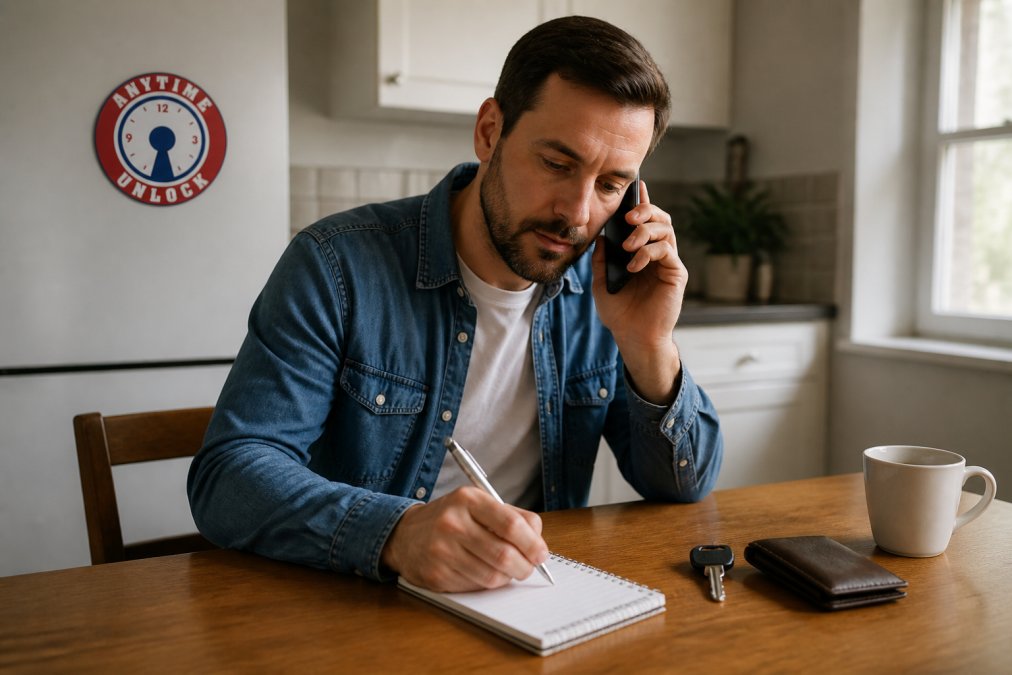
Follow this sequence:
- Describe the job precisely: "I'm locked out of a 2019 Honda Civic" beats "I need help with my car."
- Ask for the total, itemized: service call fee, labor, parts, and any after-hours fee.
- Request the quote by text or email so you have a record.
- Confirm the technician's name and estimated arrival time.
- Repeat the total back and ask, "Is that the full amount I'll pay?"
If the person on the phone won't put the number in writing, treat that as a no. A transparent operator has no reason to hide the price. For a broader look at how quotes should be structured, the consumer resources from USA.gov outline how to file a complaint when a service provider misrepresents costs.
Locksmith Price Gouging Warning Signs
Locksmith price gouging follows a predictable script: a phone quote that sounds too low, ending with a demand for cash at the curb.
Watch for these signals:
- A quote dramatically below every other estimate you gathered
- No physical address, only a call center or a generic website
- A demand for cash only, with no receipt offered
- A price that changes the moment the technician sees the lock
- Pressure to sign or pay before you've seen an itemized invoice
The service call fee, also called a trip charge, is legitimate and standard. What isn't is a trip charge that appears after the phone quote claimed the price was all-inclusive. Ask upfront whether it's included.
The Bait-and-Switch Pricing Tactic
The bait-and-switch pricing tactic is the most common locksmith scam, and it works because the customer is stranded. A dispatcher quotes low, then the technician claims the job is "more complex" than described.
Common justifications include a "high-security" lock, a "damaged" cylinder, or an emergency surcharge never mentioned. None should surprise you if you asked for an itemized quote by text.
How to Verify a Locksmith's Credentials Before They Arrive
Credential verification takes under five minutes and is the strongest defense against fraudulent billing. Do it while you wait, not after the work is done.
The Three Documents to Demand
A legitimate locksmith can produce all three on request, usually by text before arrival:
- State or local license number, the number itself, not just the word "licensed." In states that regulate locksmiths, the number is tied to a named individual or business entity.
- Certificate of insurance, a COI naming the company and showing general liability coverage. Ask the insurer to confirm the policy is active if anything looks altered.
- Surety bond confirmation, the bond is what pays you if the company damages your property and refuses to cover it. A bond is separate from insurance; ask for both.
Where to Actually Look Them Up
Verification is only as good as the source. Work from official records, not the company's website:
- State licensing board or department of licensing. Many states publish a searchable license lookup showing status, expiration, and disciplinary actions. Search your state's site directly rather than clicking a link the locksmith sends.
- Secretary of State business entity search. Confirms the business is registered, its registered agent, and how long it has existed.
Match the Vehicle, the ID, and the Name
Why This Prevents Hidden Fees
Payment Protection Strategies and Post-Service Audits
Why Card Payment Beats Cash
How a Chargeback Actually Works
Bond Claim vs. Insurance Claim
What a Compliant Itemized Invoice Looks Like
The Walk-Through Audit
Before the technician leaves, do a physical audit:
| Problem | Prevention Step | Recovery Step |
|---|---|---|
| Inflated final bill | Get written quote by text | Dispute in writing, then chargeback under the Fair Credit Billing Act |
| Cash-only demand | Insist on card payment | File complaint with state regulator |
| Damaged lock or door | Confirm liability insurance and get the COI | File claim against the insurer, not just the company |
| Bond-related loss | Verify bond number before hiring | File a claim against the surety bond |
| No-show or late arrival | Confirm arrival window in writing | Dispute any trip charge |
Conclusion: Lock In a Fair Price Before You Hand Over Your Keys
Frequently Asked Questions
What is the average call out fee for a locksmith?
There is no single national average, but reputable locksmiths typically separate their bill into a service call fee plus labor. Legitimate companies will disclose both upfront. If a dispatcher quotes an unusually low number like $15 or $25, that is often a bait-and-switch tactic designed to get a technician to your door before the real price is revealed. Always ask for the total estimated cost, including the trip charge, before you agree to dispatch.
Can you dispute a locksmith charge if it exceeds the quote?
Yes. If the final bill is higher than the written estimate you received, you have grounds to dispute the charge with your credit card issuer under the Fair Credit Billing Act. Keep your written estimate, itemized invoice, and any text or email confirmations. File the dispute in writing within 60 days of the statement date. Paying by credit card rather than cash or debit gives you this leverage, which is one of the best payment protection strategies available.
How can I verify a locksmith's legitimacy before they arrive?
Ask for the company's full legal name, physical business address, and license number, then cross-check them against your state's licensing board or consumer protection database. Confirm the business has a real local address, not just a call center. Request proof of general liability insurance and a written estimate that itemizes the service call fee, labor costs, and any hardware charges. A legitimate locksmith will provide all of this without hesitation.
What should be included in a professional locksmith's written estimate?
A written estimate should itemize the service call fee or trip charge, the labor rate, any after-hours fee, and the cost of parts such as lock hardware or key blanks. It should also state the total expected cost and whether the price is a flat rate or hourly. Vague line items like 'service fee' or 'miscellaneous charges' are a red flag. Ask for the estimate in writing before work begins, and keep a copy for your records.