 how-to
How to Avoid Locksmith Scams: 7 Red Flags to Spot
Table of Contents
- Why Locksmith Scams Target People in Emergencies
- 7 Red Flags of Locksmith Scams to Spot Before You Pay
- How to Verify a Locksmith License and Credentials
- Locksmith Bait and Switch Tactics: How the Quote Changes
- Questions to Ask a Locksmith Before Hiring
- Step-by-Step: How to Avoid Locksmith Scams in an Emergency
- What to Do After You've Been Overcharged or Scammed
- Frequently Asked Questions
Last Updated: September 18, 2026
Why Locksmith Scams Target People in Emergencies
A locksmith scam quotes a low price, then demands far more once the technician arrives and your options are gone. This guide from Anytime Unlock and George’s Key Shop explains how to avoid locksmith scams before you pay.
Three things make you a target:
- Urgency: you cannot wait for a second opinion
- No time to compare: you take the first quote you hear
- Payment pressure: you pay before you think
7 Red Flags of Locksmith Scams to Spot Before You Pay
The clearest sign of a locksmith scam is a quote that sounds too low and a technician who arrives without identification. Watch for these seven red flags.
- Unmarked vehicle with no company logo
- No uniform or professional identification
- Toll-free number instead of a local one
- No local business address on the website
- Cash-only demand at the door
- No written quote before work starts
- Price jumps the moment the lock is open
Unmarked Vehicles and No Uniform
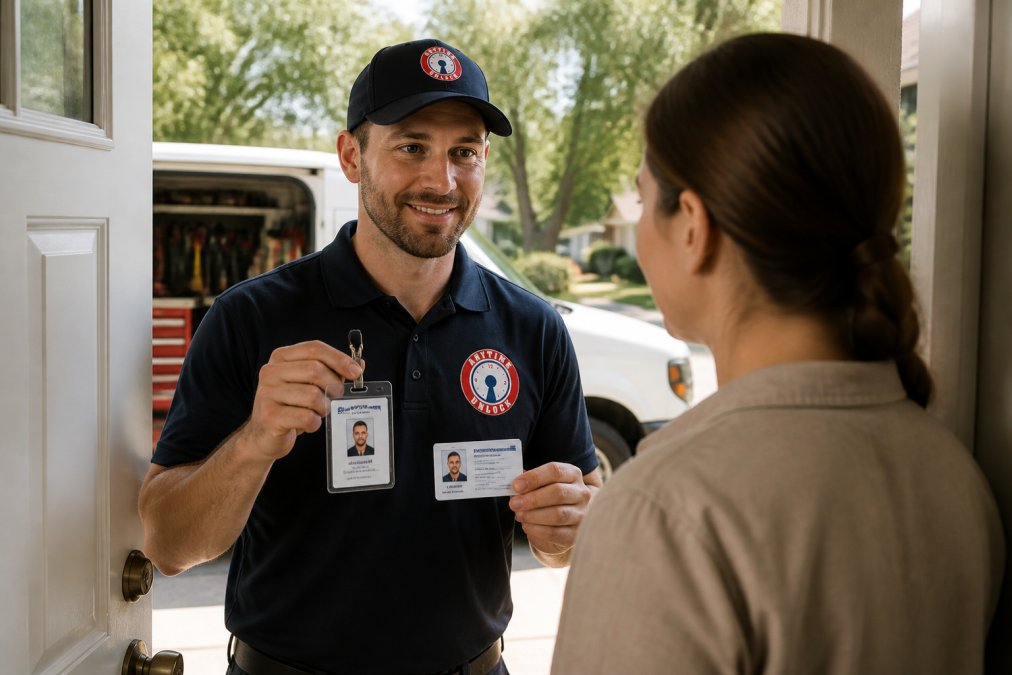
A real locksmith arrives in a marked van, wears a uniform, and can show a company ID or business card. Ask to see identification before any work begins, a legitimate technician expects this.
Toll-Free Numbers and No Local Business Address
Search for a locksmith and you will see plenty of listings with 800 numbers and no street address. These are often call centers that dispatch whoever is closest, adding cost and removing accountability.
Cash-Only Demands and No Service Invoice
Cash-only is a red flag for one reason: no paper trail. A legitimate locksmith provides an itemized invoice listing the work done, the parts used, and the final price. Credit card payment also gives you dispute rights that cash does not.
How to Verify a Locksmith License and Credentials
Verifying a locksmith starts with three checks: a state or local license, proof of insurance, and a verifiable business address. Many states and cities require locksmiths to hold a license, so ask for the number and confirm it with the issuing agency.
Here is the verification checklist we recommend:
- Ask for the license number and issuing state or city
- Confirm the license with the agency directly
- Ask for proof of insurance and a policy number
- Check the business address on a map
- Read recent online reviews for pricing complaints
- Confirm the technician's name matches the dispatch record
- Get the full quote in writing before work starts
Locksmith Bait and Switch Tactics: How the Quote Changes
Bait and switch happens when the phone quote and the final bill do not match. The dispatcher quotes a low number to get you to say yes. The technician then invents reasons to charge more: a "security lock," a "special tool," or a "hardware fee."
Common tricks include:
- Quoting a "starting at" price that only covers the simplest job
- Adding a labor charge that was never mentioned
- Claiming your lock type requires a premium part
- Raising the price once the door is already open
Questions to Ask a Locksmith Before Hiring
Asking the right questions separates a real business from a scam in under two minutes. Use these on every call.
- What is your full price, including labor and parts?
- Do you have a license number I can verify?
- Are you insured, and what is the policy number?
- What is your local business address?
- Will you provide a written invoice?
- Do you take credit cards?
- How long until you arrive?
Step-by-Step: How to Avoid Locksmith Scams in an Emergency
Most guides assume you have time to compare three quotes. In a real lockout, you do not, which is why scammers target emergencies. So the protocol splits: locked out right now, versus planning a lock change next week.
If you are locked out right now
You have maybe five minutes. Spend them like this:
- Do not call the first sponsored result. Paid ads at the top of search results are frequently call centers, not local locksmiths. Scroll past them.
- Search with your city and "locksmith" plus a neighborhood or landmark. A business that names your area is more likely to actually be there.
- Open the website and look for a street address. Copy it into a maps app. If the pin lands in a vacant lot or an unsigned house, close the tab.
- Call and ask three questions first: What is the total price for a lockout at my address, including labor and any service call fee? What is your license number? What is your business address? A real local locksmith answers all three without hesitation.
- Get the quote in a text or email. A scammer will resist; a legitimate business will send it.
- At the door, before any tool comes out, confirm the price again. Say the number out loud: "You quoted $X total. Is that what I am paying?" Get a verbal yes.
- Pay by credit card and ask for an itemized invoice. If they only take cash, send them away.
If a technician refuses any step, say no and close the door. A two-hour wait for a real locksmith costs far less than a $400 surprise bill.
If you are planning a lock change, rekey, or installation
Non-emergency work is where you have real leverage. The vetting is the same three checks, license, insurance, address, but you can do them properly.
- Get three written quotes for the same job description. Compare line items, not just totals.
- Ask what brand of hardware they install and whether you can supply your own. Some shops mark up hardware heavily.
- Confirm the technician who will arrive and whether they are an employee or a subcontractor. Subcontracting is legal but changes who is accountable.
- Schedule during business hours. Emergency and after-hours rates are where bait-and-switch pricing lives.
- Ask for the license and insurance documents by email before the appointment. A real business sends them without drama.
The one rule that applies to both
Never let the price be decided after the work is done. Whether you are locked out at midnight or booking a rekey for Tuesday, agree the number in writing before a tool touches the lock. Urgency is the scammer's tool, remove it from the pricing decision and you remove most of their leverage.
What to Do After You've Been Overcharged or Scammed
Most guides stop at "report it." That is not a recovery plan. If you have already paid a scammer, your outcome depends on how you paid and how fast you act.
Step 1: Freeze the paper trail (same day)
Before you call anyone, capture everything while it is fresh:
- Photograph the technician, the vehicle, and any license plate
- Screenshot the text or email quote and the call log entry
- Save the invoice, even if handwritten
- Note the arrival and departure times
- Write down the exact words used to justify the price jump
Step 2: Dispute the charge with your card issuer
Under the Fair Credit Billing Act, you generally have 60 days from the statement date to dispute a charge for services you did not receive as agreed. Call the number on the back of your card and say "I am disputing this charge" to start the formal clock.
What to tell them:
- The quoted price versus the charged price
- That the work was performed under duress (you were locked out and could not reasonably refuse)
- That no written quote matched the final invoice
- That you have photos, texts, and the invoice
Step 3: File complaints in parallel, not in sequence
Filing one complaint and waiting is a mistake. File all of these within the same week:
- Your state attorney general's consumer protection division. Most states accept complaints online. This is the office that can act on a pattern of complaints against the same business.
- The Federal Trade Commission at ReportFraud.ftc.gov. The FTC does not resolve individual cases, but it builds cases from volume. Your report matters to the next victim.
- Your state or local consumer affairs office, if your city or county has one.
- The Better Business Bureau, not a government agency, but a complaint there is public and often prompts a response.
- Your state's locksmith licensing board, if locksmiths are licensed where you live. A licensing complaint can threaten the scammer's ability to operate.
Step 4: Warn the next customer
Leave a factual review on Google, Yelp, and any platform where the business is listed. Stick to verifiable facts: the quoted price, the charged price, the date, and the vehicle description. Avoid insults, defamation claims are a real risk, and a calm, specific review is more persuasive anyway. If the listing shows a fake address, report it; both platforms remove listings tied to nonexistent addresses.
Step 5: Know what recovery actually looks like
Be realistic. A successful chargeback returns the disputed amount, but not your time. A licensing complaint may take weeks, and an attorney general's office may never contact you individually, it acts on patterns, not single cases. Those who recover money almost always paid by credit card and filed within the 60-day window. Everyone else is filing for the record.
Frequently Asked Questions
What are the most common signs of a locksmith scam?
Watch for unmarked vehicles, no uniform, and a technician who refuses to show ID or a license. A quote that jumps from $40 on the phone to several hundred dollars on site is a classic bait-and-switch. Cash-only demands with no service invoice, toll-free numbers with no local business address, and pressure to pay before the work is finished are all signs you may be dealing with a rogue locksmith.
How can I verify if a locksmith is legitimate before they arrive?
Ask for the company's full legal name, street address, and license number while you're still on the phone. Search that name in your state's licensing database and check the address on a map to confirm it's a real business location. Look at online reviews and the company's digital footprint, including how long the domain has existed. A legitimate locksmith will answer these questions without hesitation and can email a written service quote before dispatch.
Why do some locksmiths provide low quotes over the phone and higher prices in person?
This is the core of locksmith bait and switch tactics. A low phone quote gets you to commit, then the technician arrives and claims the job is harder than described, adds hidden fees for labor costs, or invents a call-out fee. Because you're locked out and in a hurry, you feel forced to pay. Get the total price in writing, including any after-hours charge, before you agree to the service.
What should I do if I suspect I have been overcharged by a locksmith?
Do not pay in cash if you can avoid it. Use a credit card so you have a record and dispute rights under your card issuer's consumer protection policy. Request an itemized service invoice before payment. If the technician refuses or threatens you, call local police. Afterward, file a complaint with your state's consumer protection office and leave a factual review. Keep photos of the vehicle, the technician, and any paperwork you received.
Getting locked out is stressful enough without worrying about being overcharged. At Anytime Unlock and George’s Key Shop, we have served drivers, homeowners, and business owners since 1971, with 24/7 mobile service and a team that handles auto, residential, and commercial lock work. We confirm the price before we start and stay in contact until the job is done. Get a free quote from Anytime Unlock and George’s Key Shop and skip the guesswork.