 listicle
Best 3 Lock Options for a Detached Garage
Quick Summary
The best 3 lock options for a detached garage are a keyed deadbolt for the side entry door, a keyed T-handle lock for the main overhead door, and a manual slide bolt as a secondary interior lock. Choose each based on how the door opens and who needs access. Best 3 lock options for a detached garage are chosen by matching each door's construction to the lock.
- Use a keyed deadbolt rated ANSI/BHMA Grade 1 or Grade 2 on the side entry door.
- Grade 3 builder-grade hardware is the minimum, not the target.
- Install deadbolts with three-inch screws that reach the wall framing, not the short kit screws.
- Confirm a T-handle's shaft length and latch style match your door type before buying.
- A manual slide bolt adds interior resistance but cannot lock the door from outside.
Table of Contents
- Why a Detached Garage Needs Its Own Lock Plan
- How We Ranked the Three Options
- Option 1: Keyed Deadbolt for the Side Door
- Option 2: Keyed T-Handle Lock for the Main Door
- Option 3: Manual Slide Bolt as a Secondary Lock
- Quick Comparison Table and Pros and Cons
- How to Secure a Detached Garage Beyond the Lock
- Rekeying a Garage Lock and Booking Your Upgrade
- Frequently Asked Questions
Why a Detached Garage Needs Its Own Lock Plan
A detached garage often holds tools, mowers, bikes and sometimes a second vehicle, yet it usually has weaker locks than the house, which is why choosing the Best 3 lock options for a detached garage matters so much. Many homeowners treat the garage as an afterthought. That is the mistake. A detached structure stands apart from the house, so neighbors, a porch light or a passing car may be the only witnesses to anything that happens there. The weak point in these buildings is often the same: one cheap lock on a door that gets used every day.
Think about how you actually enter the garage. Most people use a main overhead door, a side entry door, or both. Each opening needs its own plan. Many people also lose track of spare keys, so a lock you cannot control is a lock you cannot trust. When you compare the Best 3 lock options for a detached garage, pick a lock that matches how the door opens, who needs access, and how often you go in and out.
How We Ranked the Three Options
We ranked these options on four practical criteria: how well the lock resists forced entry, how easily it fits common garage doors, how simply it can be operated and rekeyed, and whether you can lock it from outside. We did not rank by brand loyalty or by the lowest price. Pricing depends on the lock, the door, and the installer, so request a quote for current figures.
Keep in mind that a lock is only one layer. A strong lock on a weak door frame still fails. Check hinges, strike plates and door condition before you buy anything.
Option 1: Keyed Deadbolt for the Side Door
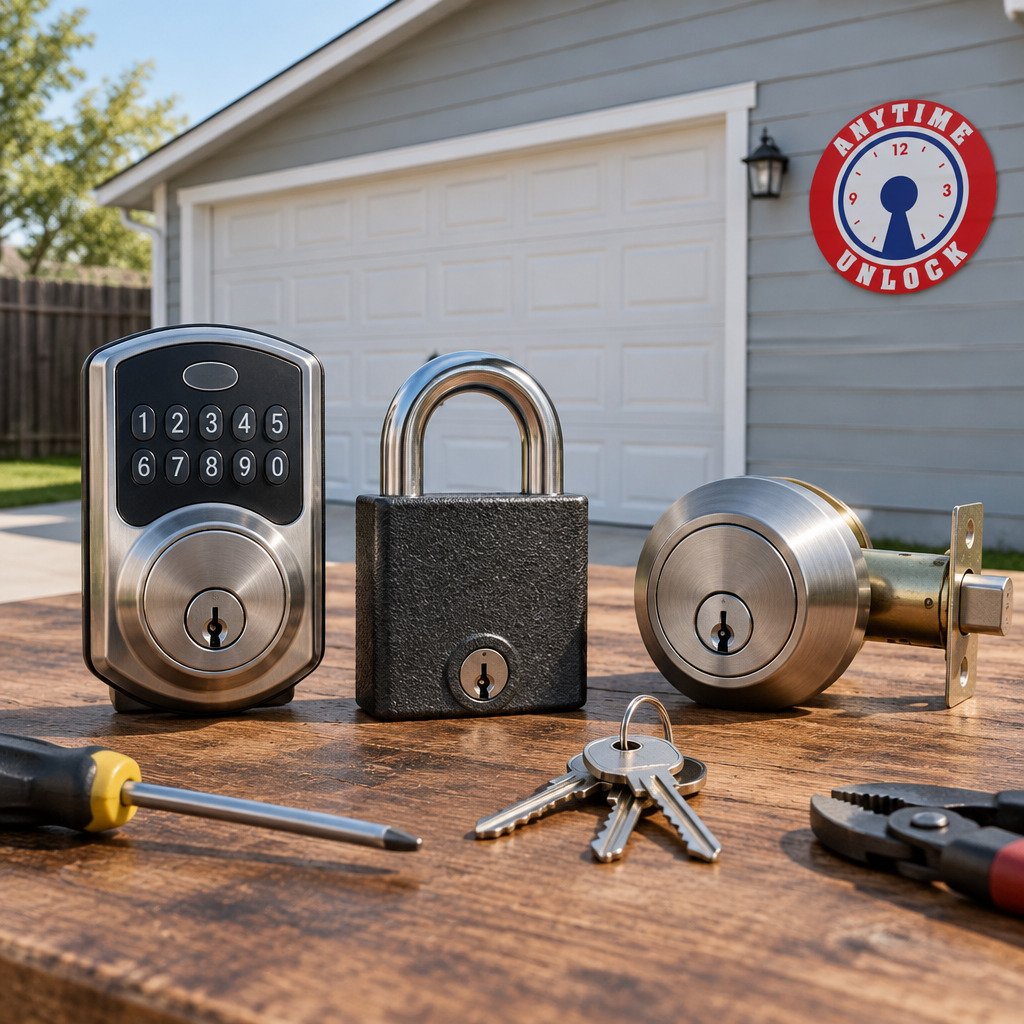
A keyed deadbolt is the strongest single choice for a side entry door on a detached garage, and it is the option most locksmiths recommend first when the door is a standard swing door rather than an overhead panel. The bolt throws into the jamb instead of relying on a spring latch, so kicking or shimming the door does not defeat it the way it defeats a knob lock.
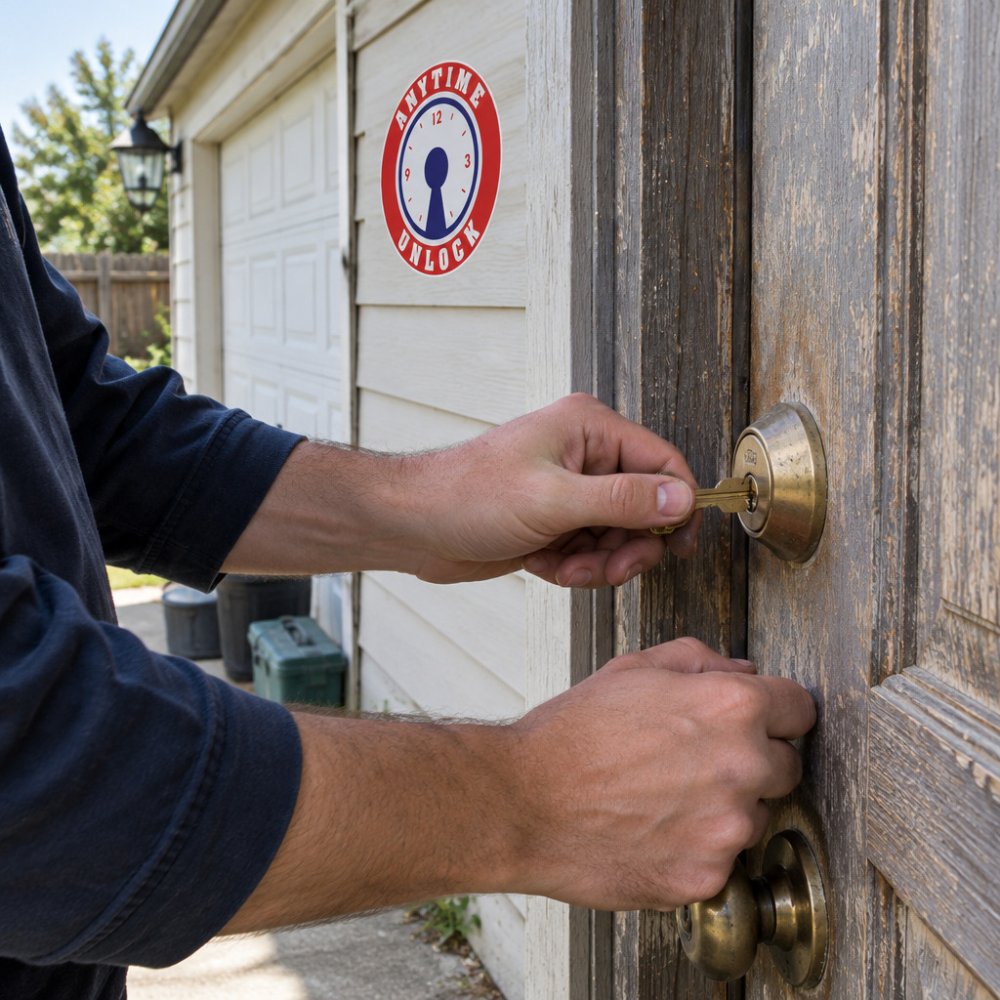
What to specify. Ask for a deadbolt rated ANSI/BHMA Grade 1 or Grade 2. Grade 3 is the builder-grade hardware sold in big-box kits and is the minimum, not the target. The bolt should be hardened steel with a full one-inch throw. The strike plate should be reinforced and secured with three-inch screws that reach the wall framing, not the one-inch screws that come in the box. On a metal side door, confirm the deadbolt is rated for metal doors and that the door has a internal reinforcement plate behind the cylinder; a cylinder mounted in thin sheet metal can be twisted out.
Single-cylinder vs. double-cylinder. A single-cylinder deadbolt has a key outside and a thumb turn inside. A double-cylinder deadbolt has a key on both sides, which stops an intruder from reaching through a nearby window or glass panel and turning the thumb turn, but it also means anyone inside needs a key to get out. In a detached garage where people work, store flammables, or use power tools, a double-cylinder deadbolt on the only exit is a safety hazard.
Fit and installation. Confirm the door thickness (most residential doors are 1-3/4 inches) and the backset, the distance from the door edge to the center of the cylinder, which is typically 2-3/8 or 2-3/4 inches. A deadbolt that does not match the existing bore will need a new hole or a wrap plate. On a wood door, the jamb must be solid; a hollow or rotting jamb will split under force no matter how good the lock is. On a steel door, use a mounting plate and check that the frame has a reinforced strike pocket.
Cost. Pricing depends on the grade, finish, and installation needed for your door. Request a quote for your door rather than assuming a kit price covers the job.
Watch out: a deadbolt installed with the short screws from the kit, into a soft jamb, gives a false sense of security, the bolt can be pried out with one firm push. The screws and the strike plate matter as much as the lock body.
Option 2: Keyed T-Handle Lock for the Main Door
A keyed T-handle lock is the practical choice for a main overhead door on a detached garage that has no automatic opener, and it is also the option most often mis-sold because T-handles are not interchangeable across door types. The handle turns a shaft that drives a latch bar or slide bolt into the door track or floor, so the door is held by the lock itself rather than by the opener's trolley.
Match the lock to the door construction. Sectional doors (the common paneled overhead door) use a T-handle that mounts through the door face and engages a latch bar into the vertical track or a floor plate. Roll-up doors (the coiled steel service-door type) typically use a different T-handle with a side latch that engages the door guide. One-piece tilt-up doors use yet another pattern. Before buying, identify the door type, measure the existing cutout, and confirm the lock's shaft length and latch configuration match. A T-handle that is the wrong length will not engage the track and will look installed while providing no real resistance.
Opener compatibility. If the garage has an automatic opener, a keyed T-handle can still be used as a manual backup lock, but it must be released before the opener is cycled or the opener will fight the latch and damage the door or the operator. Many openers have a disconnect cord or a vacation lock; understand how yours works before adding a manual lock. On an opener-equipped door, the more common approach is an outside keyed disconnect or a lock that the opener is designed to work with, rather than a standalone T-handle.
Security limits. A T-handle is only as strong as the door panel it mounts through. On a thin steel or aluminum panel, the mounting plate spreads the load, but a determined attacker can still deform the panel. Pair the T-handle with a reinforced mounting plate and, where the door type allows, an interior slide bolt or latch that adds a second point of resistance.
Cost. Pricing depends on the lock and the door type, so request a quote for your specific door.
Watch out: buying a T-handle by photo alone is the most common failure, the shaft length and latch style must match the door, and a return that 'almost fits' leaves the door unsecured.
Option 3: Manual Slide Bolt as a Secondary Lock
A manual slide bolt is a simple, inexpensive secondary lock. It secures the door from the inside and adds a second point of resistance. It works best paired with a keyed lock, not as a standalone defense.
The advantage is that a slide bolt cannot be picked or rekeyed by an intruder, and it needs no electricity or batteries. The drawback is that it locks from inside only. If you use it on a side door, make sure you can still exit safely in an emergency. Never block the only exit from a garage that people work in.
Quick Comparison Table and Pros and Cons
| Lock Type | Best Placement | Locks From Outside | Pros | Cons |
|---|---|---|---|---|
| Keyed deadbolt | Side entry door | Yes, with key | Solid bolt, strong resistance, simple to use | Needs correct installation to perform well |
| Keyed T-handle | Main overhead door | Yes, with key | No opener needed to lock, fits many doors | Fit depends on door construction |
| Manual slide bolt | Interior of side or main door | No (interior only) | Low cost, no power needed | Cannot secure from outside, supplements other locks |
Keyed deadbolt pros: strong bolt, familiar operation. Cons: installation quality matters.
T-handle pros: exterior keyed access, no opener dependency. Cons: fit varies by door.
Slide bolt pros: simple and inexpensive, no power required. Cons: interior only, not a complete solution alone.
How to Secure a Detached Garage Beyond the Lock
A lock alone rarely makes a garage secure. Low-cost ways to harden the garage can add protection without a big budget. Broader upgrade options are covered in our security guide for the rest of the property. Start with lighting. Motion-activated lights on the approach to the garage make it harder for someone to work unseen. Trim shrubs that hide the door, and keep ladders and tools out of sight from the street.
Secure windows as well. Small garage windows are often overlooked, so consider privacy film or window locks. Check the overhead door's emergency release and make sure it cannot be opened from outside with a simple tool. Finally, store valuables out of view and keep a record of serial numbers for expensive equipment.
Rekeying a Garage Lock and Booking Your Upgrade
If you have lost a key, bought a home with unknown keys in circulation, or want one key for the house and garage, rekeying is often the simplest fix. Rekeying changes the internal pins so the old key stops working. Ask a licensed locksmith to confirm whether your existing hardware can be rekeyed or needs replacement. See a breakdown of what rekeying a home typically costs before you decide.
If you are ready to upgrade, Anytime Unlock and George's Key Shop, the oldest locksmith company in Lubbock, established in 1971, offers residential locksmith services and mobile service. Contact us for a free quote to discuss the right combination of locks for your garage.
Frequently Asked Questions
What is the best type of lock for a detached garage?
For most detached garages, a keyed deadbolt on the entry door is the strongest single choice, because a deadbolt throws a solid bolt into the frame and resists prying far better than a spring latch. A T-handle lock is a good match for a roll-up door that has no opener-side lock. The right pick depends on your door type and on whether you need keyed access from outside. Compare the three options in this guide before you buy, and confirm that the hardware fits your door thickness and frame before you order.
Should a detached garage have a deadbolt?
Yes, if the garage has a swinging or side entry door. A deadbolt adds a second, independent locking point that does not rely on the door handle, and it is harder to defeat with a simple tool than a padlock on a hasp. Pair the deadbolt with a strike plate fastened into solid framing with long screws, since a weak frame can undo even a high-quality lock. A deadbolt does not protect a roll-up door, so the main overhead door needs its own lock.
Is a padlock secure enough for a garage?
A padlock is a deterrent, not a complete solution. Its strength depends on the hasp and the screws holding it. A thin hasp fastened with short screws can be pried off in seconds, while a heavy-duty hasp with through-bolts and a hardened shackle is much harder to defeat. If you use a padlock, choose one with a hardened shackle, mount the hasp so the screws cannot be reached from outside, and treat it as one layer alongside a deadbolt or T-handle lock.
Can you add a deadbolt to a garage side door?
In most cases, yes. A side door of a detached garage usually has enough thickness and framing to accept a standard deadbolt, though a door that is hollow or thin may need reinforcement. Check the door's thickness and the bore size of the deadbolt you choose before buying. If the door has a lock already, rekeying it or replacing the cylinder may be simpler than installing an entirely new lock. A professional locksmith can confirm fit in a single visit.